Winslow Chapels

Winslow has a strong nonconformist tradition. The Baptist meeting house was built in 1695 in the garden of a local draper named William Gyles. Non-conformist meeting houses of this period tend to be discreetly sited to avoid the sort of persecution which marked the career of Benjamin Keach, the popular 17th century local preacher, after whom the chapel is now named.

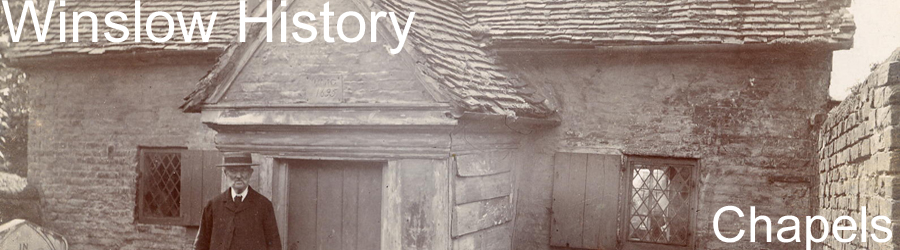
Keach's Chapel, with Mr Wichello

The first document below is the will of the founder of the meeting house, William Gyles of Winslow, woollen draper, which was proved in the Prerogative Court of Canterbury, 28 May 1713. The original is at the National Archives at Kew, but a facsimile is available on line from the National Archives website.

Will of William Gyles of Winslow in the County of Bucks Woollen Draper 6 March 1712/13

In the name of God Amen I William Gyles Winslow in the County of Bucks Woollen Draper being at present surprized with sickness and not knowing how it will please God to dispose of me for life or death but wholly submitting myself to his blessed Will and humbly with hearty sorrow for my sins recommending my soul to the hands of my Gracious God trusting for Salvation by and through the merritts of Death and Passion of my Lord and only Saviour Jesus Christ and Comitting my body to the Earth to be decently Interred at the discretion of my Executrix and hereinafter named as touching my Worldly Estate doe make this my last Will and Testament as followeth And whereas I have made a surrender of my Copyhold Estate of Lands Tenements & Hereditaments whatsoever within the Manner of Winslow aforesaid to such Uses Intents and purposes as I should mention express and declare in my last Will and Testament Now as for and concerning All that Messuage Tenement wherein I now dwell with the Appurtenances thereof I give and devise the same unto my son William Gyles To Hold to the said William Gyles immediately after the decease of my said Wife Sarah and unto his heirs for ever My Will further is That that part of my house in which Richard Allen lately dwelt next the house of William Firth in Winslow aforesaid as the same was then and is now divided with One Bay of building standing behind the same and adjoining to the Churchyard with liberty of ingresse egresse and regresse in and through the Entry under that part of my house late in the occupation of Richard Gibbs at all Seasonable times to and from the said Bay with the Appurtenances shall be enjoyed by my daughter Grace for and during the Terme of her Natural life from and immediately after the decease of my said wife Sarah and after her decease by the heirs of the Body of the said Grace and for want of such Issue by my right Heirs for ever And my will further is That part of my house in which Richard Gibbs lately dwelt in Winslow aforesaid adjoining to that part late in the occupation of Richard Allen as the same was then and is still divided with the appurtenances thereof shall be enjoyed by my daughter Martha for and during the Terme of her Natural life from and immediately after the decease of my said Wife Sarah and from and after the decease of my said daughter Martha by the Heirs of the Body of the said Martha and for want of such Issue by my right Heirs for ever And my will likewise is that my Messuage or Tenement in which Thomas Gibbs now dwells in Winslow aforesaid known by the sign of the Angel with the appurtenances thereof shall be enjoyed from and immediately after the decease of my said wife Sarah by my said daughter Jane for and during the Terme of her Natural life and from and after her decease by the Heirs of the Body of the said Jane and for want of such Issue by my right Heirs for ever Item I give devise and bequeath to my said son William Gyles and to his Heirs for ever All the rest of my Copyhold Lands Tenements and Hereditaments whatsoever which I hold of the said Manor of Winslow and which I have not herein disposed off and whereof I have any power to dispose Provided neverthelesse and my mind is That if my said son William shall dye without Issue of his Body Then the Heirs and Assigns of the said William my son shall within twelve months after his decease well and truly pay or cause to be paid unto such of my daughters as shall be then living out of my said Copyhold lands Tenements & Hereditaments the sum of One Hundred pounds apiece And in Case the person or persons who shall be Entitled to the said Copyhold Lands and Tenements shall neglect or refuse the same at the time aforesaid according to the true Intent and meaning of this my Will Then I give and devise the same premises unto Such of my Daughters as shall be living at the decease of my said son William and to their Heirs for ever to be equally divided between them All the rest and residue of my Goods Chattells and personal Estate whatsoever and wheresoever either upon Serurityes or otherwise I give and bequeath the same unto my said Deare Loving Wife Sarah Gyles whome I make full and Sole Executrix of this my last Will and Testament And I doe hereby revoke all former Wills by me heretofore made And doe declare this only to be my last In Witnesse whereof I have to this my last Will conteined in Six Sheets of Paper to the ffive first sett my hand and to the last my hand and seale this Sixth Day of march in the Eleventh Year of the Reign of Queen Anne over great Brittain Anno Domini One Thousand Seven hundred and Twelve

Signed Sealed and Delivered by the said
William Gyles and by him published to be William Gyles
his last Will and Testament in the presence of
Samuel Norman
William Simes
John Markham


Arthur Clear: A Thousand Years of Winslow Life (1888), pp.17-18 on Benjamin Keach

In consequence of the Scarcity of Copper money during the Commonwealth, and the reign of Charles II, many thousand varieties of "Tradesmen's Tokens" were put into local circulation, so that to quote an old writer, "everie chandler, tapster, vintner, and other tradesmen, made tokens of lead and brasse for halfpences." In Buckinghamshire the number of known varieties is about 160, of which the following were issued at Winslow.
WILLIAM GILES, W.G.M.==OF WINSLOW, 1666.
JOHN FOEEEST, I.F.M. OF WINSLOW, ==HIS HALF-PENNY, 1666.
MATHEW BISHOP X M.B.D.==IN WINSLOW.
THOMAS SMALLBONES==OF WINSLOW, T.A.
This person was Churchwarden of Winslow in 1670, and his name is placed on the third Bell cast in that year. It would seem that this must have been "the good old time" so often spoken of. The Parish had now got their new peal of Bells, and the Country had recently been blessed with an "unspeakable mercy," as the Prayer Book puts it, by the Restoration of that "most gracious Sovereign" King Charles II, who had accorded to his people "the public and free profession of true Religion and Worship." So that the Nonconformists of Winslow had ventured to open a Meeting-house in a retired spot, then called "Pillars Ditch." But they soon found that the true religion etc., spoken of, was only meant to apply to the doctrines of the Church of England. In 1660, Benjamin Keach was chosen pastor of this little Baptist Church. He was a native of Stoke Hammond, and had recently married Jane Grove, a resident of Winslow. He was a powerful preacher, and in after years proved himself a voluminous writer, and a poet of no mean order, but it is chiefly for the courageous fidelity in which he bore witness for Christ and His cause, without fear of man, that his name should be kept in remembrance. Keach had only been settled a short time at Winslow before he was called upon to endure persecution and suffering. For the Authorities soon determined to suppress these meetings of the Dissenters, and they speedily paid Winslow a visit. Keach was preaching at the time and the troopers seized him with great violence, and swore they would kill him, and after treating him with great indignity, they tied him behind one of the troopers, across his horse, and so conveyed him to prison, where he suffered great hardships. It is not our purpose to narrate all the persecutions he was called upon to undergo and his imprisonment and sufferings in the pillory, both at Aylesbury & Winslow where his books were burnt in the Market-place by the common hangman. He continued his ministry at Winslow, until 1668, but being constantly harrassed by the civil powers, he removed to London, where he was chosen pastor of a small congregation in Tooley St., Southwark, with whom he remained till his death, in 1704. This church among whom Keach so long and successfully laboured, is now (after sundry migrations upon account of London improvements) located at Newington, in the Metropolitian Tabernacle, under the Rev. Charles H. Spurgeon.


The following document is from the Winslow Court Books in which all transactions concerning copyhold property in the town were recorded. It is a 1774 surrender by the surviving trustees of the Baptist Meeting House and the admission of new trustees who will be responsible for the upkeep of the building and the continuation of Baptist worship in Winslow.

30 Sept 1774, Centre for Bucks Studies D 82/1 page 175

Surrender:
James Hall of Winslow gentleman
John Hall of Winslow mason son of the said James Hall

Admission:
Samuel Norman of Henley upon Thames Esquire
William Britain of the City of London tallow chandler
John Shenstone of the City of London silk dyer
William Aldridge the younger of Red Lion Passage Holborn London working goldsmith
Francis Cox of Bletchendon Waddesdon dairyman
Samuel Shenstone of Stony Stratford tallow chandler
Richard Cox of Westbury House Shenley dairyman
William Cox of Tatenhoe dairyman

All that piece or parcel of Ground in Winslow aforesaid within the said Manor heretofore parcel of a close the Home Close late belonging to Daniel Gyles late of Winslow aforesaid linen draper deceased which said piece or parcel of ground was divided from the other part of the said Close by William Gyles deceased father of the said Daniel Gyles deceased to erect thereupon a House or Building called a Meeting house for such people who are or shall be called or distinguished by the name or Names of Baptists dissenting from the Way and Communion of the Church of England and presbytery for to meet in for to worship and serve God

And also the House and Building since erected thereupon called the Meeting House and the appurtenances thereunto belonging which said piece or parcel of ground extends from the Ground of the said James Hall (allowed from the Eaves Drops of his Barn) forty three feet and an half southward and from the Garden of the late Joseph Harding and now of Benjamin Ingram twenty five feet Eastward and also free Liberty of Ingress Egress and Regress Way and Passage at all times to and from the said building called the Meeting House and parcel of the Ground thereunto belonging in and through the Backside Yards and Gateways late belonging to the said Daniel Gyles deceased leading to and from the said meeting House into the street near to a pool there called Pillers Ditch.

In 1816, the small group of Congregationalists in Winslow purchased a barn on Horn Street to use for religious worship. It was fitted out as a chapel, capable of seating 250 people. In 1829, the Congregationalists bought further land near to extend the barn with the intention of rebuilding their chapel and adding a vestry and schoolroom.

Arthur Clear: A Thousand Years of Winslow Life (1888), p.19

On Wednesday, April 10th, 1816, a building which was originally a barn, situate in Great Horn Street, having been purchased of Mr. Edmund Cox, and considerably altered, was opened as an Independent Chapel. It is described as being a neat chapel, capable of holding about 250 persons and costing £300. For some time previous to this, the Independents had been granted the use of the Baptist Chapel on alternate Sundays; but their growing numbers necessitated, a larger building and more frequent services. It would seem that even in. those days our Independent friends were rather aspiring, for this "neat building" did not long suffice, it being pulled down, and replaced by a more pretentious structure in 1829, of which the following account is given in the Evangelical Magazine of 1830 - "A neat and commodious new Independent Chapel, with School-room and Vestry, capable of containing upwards of 300 persons, was opened for Divine Service at Winslow, on Tuesday, May 4th, 1830. The Chapel is vested in trustees, and built upon the most economical plan, the cost being about £600, of which £400 has already been raised."


26 October 1829: Centre for Bucks Studies D 82/4/498

Surrender: George Hawley of Winslow grocer and tallow chandler and Hannah his wife and
James Todd of Winslow cabinet maker
Admission: Rev Thomas Palmer Bull of Newport Pagnell
Rev Enoch Barling of Buckingham
Thomas Lomath of Winslow cordwainer

£18

So much and such part and parts of the yard and Garden adjoining and belonging to a Messuage or Tenement situate standing and being in a certain Street called Great Horn Street in Winslow aforesaid lately occupied by William Bailey and since converted into two tenements now in the occupation of the said William Bailey and John Lomath as will be required to enable the Trustees of the Independent Chapel in Winslow aforesaid to enlarge the said Chapel and the ground thereunto belonging according to certain plans lately agreed upon and intended forthwith to be carried into effect, the Wall of such new Chapel or of the Vestry Room thereto belonging to be considered as the Boundary or the Premises intended to be hereby surrendered on one side thereof such wall to be built 37 feet in length in a straight line from the street at a sufficient distance from the said tenement occupied by the said John Lomath so as to leave not less than 4 feet of ground in width between such wall and the chimney of the said last mentioned tenement and the back wall of the Vestry Room (which is to be erected in a direct line from the back Corner of the first mentioned Wall being agreed upon as part of the Boundary of the said premises intended to be hereby surrendered on the other side thereof from the Corner of which said Vestry Room to the Malting of William Bowler a boarded fence is to be put up at the expense of the said Trustees for the purpose of completing the division of the said premises intended to be hereby surrendered from the premises reserved by the said George Hawley and James Todd such boarded fence to be continued in a straight line from the Corner of the Vestry Room so as to leave for the said George Hawley and James Todd their heirs and assigns a piece of ground between such fence and the garden occupied by Robert Bowden of equal width with the piece of Ground which will after the erection of the said New Chapel according to the Restrictions aforesaid be left between such Garden and the back wall of the Vestry Room And also full and free right of ingress egress and regress way and passage into through and over the ground reserved by the said George Hawley and James Todd to and from a door intended to open into the said New Chapel on the side nearest the said Tenement in the occupation of the said John Lomath and likewise to and from a door or gate intended to open into the premises hereby surrendered on the side nearest the garden occupied by the said Robert Bowden at or near the extremity of the proposed new Vestry Room to which said premises or Tenement ... the said George Hawley and James Todd were admitted 27 October 1823 on the surrender of John Nicholls.

The first Congregational Chapel The photo shows the original Congregational Chapel before the rebuilding of 1884

In 1884, a new Congregational Church was built at a cost of £2,400. The new church seated 240 people on the ground floor and 80 in the gallery. There was a Sunday School to the right of the entrance and a large class room on the left. Prominent amongst the church's supporters were George Wigley, land agent, Edwin French, printer and Robert Williat Jones of Blake House, farmer. For more on the building and its architect, see Ed Grimsdale's article on Arthur Clear. A drawing and plan were published in Building News, 16 Jan. 1885 (click on the image below for full size). While the church was being built, the congregation met in the Assembly Rooms at The Bell.

Drawing and plan of the Congregational Church

Arthur Clear: A Thousand Years of Winslow Life (1888), pp.20-1

The new Congregational Church was erected in 1884, on the site of the older building, in Horn Street, the design is based on the lines of the smaller old English Country Parish Churches of the 15th century. The prominent feature is the tower, a square and massive erection, 58 feet in height, surmounted by a weather vane, in the upper part of which is a commodious room 17 feet square, lighted by seven windows, and used as a Sunday School Classroom - this is a peculiar feature of the building, the idea being taken from the watchman's tower at Irthlingborough Church, Northants. The building is lighted with gothic windows filled with cathedral toned glass, the principal one in the tower is very handsome - its dimensions being about 16 feet broad by 18 high, said to be a reduced copy of a celebrated one in York Minster. The building is both artistic and comfortable, and is in marked contrast to the plain and often unsightly structures to which Nonconformists in the country have long been accustomed. It is designed to seat 240 persons on the ground floor and 82 in the gallery. The total cost of its erection with the School rooms, being £2,300.

In 1885, a new Clock with Chimes, was fixed in the Church tower, and the Bells re-hung, in accordance with a bequest ofthe late D. T. Willis, Esq.

Plaque: stone laid by Mrs Verney


CONGREGATIONAL CHURCH AND SCHOOLS, WINSLOW, BUCKS.

AFTER many years of patient waiting and enduring the greatest inconvenience, especially as regards School Accommodation, the Congregationalists of Winslow have at last decided to make a vigorous effort to erect a New Church and Schools, and they earnestly appeal to the generosity of every one interested in the spread of Evangelical Truth in the Rural Districts, to aid them with their contributions.

They submit the following facts - the means of the Congregation are extremely limited, yet their promised subscriptions amount to £800. The total estimated cost, including the site, is £2,000. The Chapel Building Society have approved the work, but can only help by a loan of £200 without interest, thus necessitating £1,200 to be raised

The design of the Building is of the Early 15th Century Gothic. The Tower comprises - on the ground floor the entrance lobbies, in the central part an ample and well ventilated gallery, and the upper a commodious class-room, right and left of the Tower are the New Schools and Classroom, with the Church in the rear. The characteristics of the whole, are ample window lighting, every part of the Building utilised, and nothing built for mere show or effect.

Subscriptions may be sent to either of the undersigned, or can be paid to the account of "The Congregational Church & Schools" at the Bucks and Oxon Union Bank, Winslow.

If preferred, Contributors can specially allot their Donations to the New Church or the Schools.
JOHN RIORDAN, Pastor.
FERDINAND LOFFLER, Treasurer
ARTHUR CLEAR, Secretary.
THE DEACONS.

WINSLOW CONGREGATIONAL CHURCH
Treasurers Balance Sheet up to October 1st, 1885.

Cr.
See
£ s d
£ s d
Published By amount of Donations from Members of the Congregation only
830 3 11
Subscription By donations outside Congregation over £1
114 13 3
List. By donations under £1
1 1 0
Receipts from various sources, viz-
Jubilee Service
6 19 2
Stone-laying
62 10 7 ½
Sale of Luncheon Tickets
5 5 0
Net proceeds of Bazaar
120 10 6
Organ Fund
2 5 10
Sunday School Collecting Boxes
4 16 0 ½
Opening Services
35 14 0
Subsequent Collections
21 5 10 ½
Temperance Entertainment and Service of Song
4 0 0
263 7 0
Balance in Debt
1229 10 6
2438 15 8
Audited and found correct—
ARTHUR STEAD MIDGLEY.
ARTHUR JOSEPH CLEAR.
Dr.
£ s d
£ s d
TO LAW COSTS:
To Mr. Henry Small, Costs of Enfranchisement of Copyholds and Bill of Costs
84 0 3
To Messrs W. B. & W. R. Bull, their Bill of Costs for preparing Trust Deeds and obtaining Mortgage
51 11 0
To "Star" Insurance Co. Fees on Mortgage for £900
5 5 0

140 16 3

TO COSTS OF SITE:
To Liberator Building Society, balance of Mortgage on old Cottages
119 4 2
To Mr. W. H. French, Purchase Money of Barns and Premises
30 0 0
To Mr. Geo. Dunkley ditto ditto
100 0 0
249 4 2
TO COST OF NEW BUILDINGS:
To Messrs Yirrell and Edwards amount of Contract and all extras
1838 13 1
TO ARCHITECTS CHARGES:
To Mr. Sulman, his Bill of Charges
107 0 6
TO SUNDRIES:
To Mr. Walker, Bill for pulling down old Buildings and Cottages and putting up Gates, Fence and other Work
32 8 0
Messrs Loffler for sundry Furniture
13 4 4
School-room Seats
12 3 3
Secretary's Incidentals

2 1 4

Bucks and Oxon Bank Interest
13 6 9
To Sundry Payments by Cheque
29 18 0
103 1 0
£2438 15 8


Colour photo of the Congregational Church
The Congregational Church around the time of its closure in 1989

Copyright 22 May, 2012