- Home
- News / events
- Avenue Road
- Biggin
- Buckingham Road
- Census 1841
- Chapels
- Charities & poor relief
- Church
- Church Street
- Directories / descriptions
- Enclosure
- Families / people
- Farms
- Fire insurance
- High Street
- Horn Street
- Maps
- Market Square
- Medieval & 16th century
- 19th-20th Centuries
- Oral history
- Parish Council
- Photographs
- Pubs
- Railway
- Redfield
- Schools
- 17th-18th Centuries
- Sheep Street
- Shipton
- Station Road
- Tanneries
- Tinkers End
- Turnpike
- Vicarage & Verney Roads
- Western Lane
- Wills
- Windmill
- Winslow Hall
- Workhouse / Hospital
- World War One
- Sitemap
- Links
- Search site
- About us / contact

Workhouse / Hospital
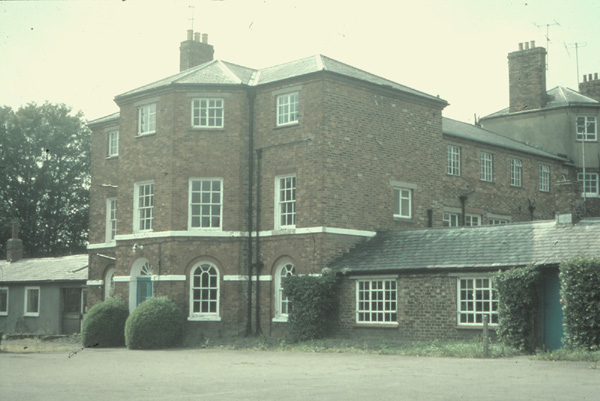
The former Workhouse (later Winslow Hospital) in the 1980s. The building at the front is the Master's House, designed by Sir George Gilbert-Scott.
Article by Glenys Warlow on poor relief in Winslow and the history of the Workhouse: workhouse.pdf
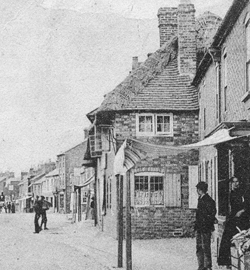 Before the Poor Law Reform Act of 1834, towns such as Winslow had their own workhouses. An Account of Several Work-houses for Employing and Maintaining the Poor (1725) lists Winslow as having a workhouse, which was built after the Poor Relief Act of 1722. In Aug 1722, trustees acquired from Daniel Gyles 6 tenements "at the Townesend of Winslowe near the Cowe Street [=High Street], the common road west, the close of Robert Lowndes esq. in the occupation of William Gibbs east" for the parish officers to make a workhouse. In 1725, the workhouse and two barns were insured for £330. A parliamentary report of 1777 says there was space for 20 inmates. The building described below on the same site as the earlier one, was on the east side of the High Street, approximately where nos.56-58 now stand (they were built in 1926). After it went out of use as a workhouse it was converted back into cottages, and later included Benbow's confectioner's shop. It is the partly thatched building in the photo on the right. Its demolition was reported in the Buckingham Advertiser of 8 May 1926: "The half-timbered and thatched building ... Many years ago it was the parish workhouse and the last house in what was then Cow Street (now High Street)."
1784, 5 April: Northampton Mercury
WORK-HOUSE to LETT.
Wanted, A Person properly qualified, and of good Character, that will undertake to Instruct
and Employ the POOR in WINSLOW WORKHOUSE, in
some Manufactory Business; and will engage for the entire
Providing, Maintaining and Clothing the Poor of the said
Parish of Winslow, in the County of Bucks. To enter
upon the Workhouse at Easter next.
For Particulars, apply to the Overseers of Winslow aforesaid.
1787, 5 May: Northampton Mercury
WANTED immediately, A sober Person in some Manufacturing Business, who is willing to contract for the Maintenance and Employment of the POOR of the Parish of WINSLOW, in the County of Bucks, till Easter-Tuesday, next. He is to reside and board in the Work-House, and see that the Poor are properly employed.
Proposals will be received by the Churchwardens and Overseers of the Poor of Winslow aforesaid.
The Building intended to employ the Poor in has been lately erected, and consists of seven Bay*.
N.B. a Man with his Wife only will not be objected to.
* A bay was the distance between vertical crucks or main timbers. Such bays were from 12 to 15 feet wide, so this newly constructed Work-House would have been 84-105 feet long.
Frederic Morton Eden, The State of the Poor vol.2 (1797), p.30
The Poor are maintained, partly, at a work-house, and, partly, at their own houses. 16 Paupers are at present in the work-house, under the care of a Contractor, who farms them at 3s. a week each, and is like-wise allowed their earnings: he received only 2s. a week before the late dearness of provisions took place. The people in the house are old women and children, and one man. Lace-making is their chief employment. Their diet is not regulated by any particular bill of fare.
The workhouse in the High Street was replaced in 1824, when the former George Inn next to The Bell was bought by the parish overseers, who were planning to erect a new building there. There was also a change from lace-making to straw-plaiting as the paupers' employment.
Arthur Clear, The Kings Village in Demesne: or a Thousand Years of Winslow Life (1894), p.117
At the back of the Bell hotel is a block of buildings now used as a malthouse, stables, etc. These at one time formed the Parish workhouse, Straw Plaiting School for boys, and a Millhouse in which the unemployed were set to work grinding corn by hand; here also was a lock up for misdemeanants.
1821, 3 Nov: Northampton Mercury
WINSLOW POOR.
WANTED, a MAN and his WIFE (if without a Family the more desirable), qualified to CONTRACT for and UNDERTAKE the MAINTENANCE and EMPLOYMENT in the Straw Plait, or some other Business of the Poor, residing in and out of the Poorhouse, and belonging to the Parish of Winslow, Bucks.
Proper References for Character and Abilities, and Security for the true Performance of the Contract, will be required.
Applications and Tenders are desired to be made (free of Expense) to the CHURCHWARDENS and OVERSEERS of Winslow, aforesaid; or Mr. CHARLES WILLIS, their Solicitor, on or before TUESDAY the 13th NOVEMBER next, on which Day a Meeting of the Select Vestry of the said Parish is intended to take Place at the Parish Church there, precisely at Six o’Clock in the Evening, for the Purpose of entering into such Contract.
Winslow, 31st October.
1823, 16 Aug: Northampton Mercury
TO BUILDERS AND OTHERS.
THE Inhabitants of WNSLOW, Bucks, being desirous of TAKING DOWN the PRESENT WORKHOUSE of the said PARISH, and ERECTING a NEW ONE, suitable for at Least one Hundred Paupers, any Persons wishing to Contract for the same, are hereby required to deliver Plans and Estimates, on or before the First Day of September next, to the CHURCHWARDENS and OVERSEERS of the said Parish, or Mr. CHARLES WILLIS, their Attorney, of whom further Particulars may be had.
Winslow, 6th August, 1823.
1823, mentioned in Essex Standard, 5 Aug 1836
N.B. The introduction of a parochial corn mill, at Winslow, worked by manual labour, was recommended by me in 1823 to Mr. Lowndes, who advanced £1,000, subject to repayment, for the erection of the workhouse. To carry this object into effect, I proposed that twelve respectable inhabitants of Winslow should first try the experiment of working the mill, before the paupers had commenced working it. This was done, and the result of the trial of the new system was, that the rates were reduced from £2,259 12s. 0½ d. in 1825, to £1,283 18s. 7d. in 1826; thus saving in one year the large sum of £975 13s. 5½ d. The adoption of the mill was advocated by me upon the attention of Earl Pomfret’s stewards in 1817-18, but was not taken up, or it would have produced more beneficial results, with those so distinguishedly recommended by me, for the system of publishing the weekly and quarterly expenditure of parishes, which were honoured by the approval of Mr. Vansittart, Earl Spencer, the Duke of Rutland, Lord Milton, and others, of which I sent a considerable distribution throughout England, for the advantages being also derived by the Nation, in eradicating innumerable abuses which parishes were much subject to, during the continuance of the war, and which then became so urgently requisite for correction by every equitable measure which could be divised. I have to regret that I did not use much further energy for publicity with both of those measures at the important crisis (1817), and which left no alternative for the surety of redress of several millions sterling, by an annual reduction of at least one-third of the parochial rates, for the mutual benefit of the tenant and the landlord.
Towcester, June 4th, 1836.
1824, 16 Oct: Northampton Mercury
WANTED immediately, A MAN and his WIFE, free of Incumbrance, to SUPERINTEND the MANAGEMENT of a WORKHOUSE.
They must have a good Recommendation as to Honesty, Sobriety, and Industry.
Apply personally, or by Letter, Post paid, to D. GRACE, Overseer, Winslow, Bucks.
1827, 7 April: Northampton Mercury
WANTED, A MILLER, to undertake the Management of A MILL worked by Men at the Poor House. A Person of good Character, and capable of Baking for the House, will be referred.
Apply personally, or by Letter, Post paid, to the OVERSEERS of Winslow aforesaid.
1827, 11 Aug: Northampton Mercury (letter to the editor)
By the seasonable aid W. Selby Lowndes, Esq., of Whaddon Hall, the parish of Winslow has been enabled to establish a workhouse, on the correct principles mentioned in the latter part of the preceding extract. The idle have been stimulated to useful exertion, the refractory have been restrained, and the helplessness of infancy and old age have had comfortable support. It is quite gratifying to see those children, who were formerly clothed in tattered garments, and were a trouble to all around them, now neatly clad, and carefully brought up in industrious habits. The poor are in a much better condition, and those who support them have both much less trouble and expense. The latter will be evident, when it is known that the expense of of [sic] the poor at Winslow, in 1825, was £2,259. 12s. 0d½. and in 1826, was only £1,283.18s. 7d. thus saving £975. 13s. 5d½. with a prospect of still greater reduction. The expense of conducting the Workhouse at Winslow would be much diminished by permitting the villages in the neighbourhood to incorporate with them. While these villages would assist in the re-payment of the borrowed money and in paying the Officers’ salaries, and all the other expenses of the house, they would support their own poor.- Thus, as it regards expense, Winslow would, in every way, be benefitted and the adjoining villages would have it in their power to send their poor to a well-regulated workhouse at a moderate rate, without being at a greater charge, in building a house, than, under existing circumstances, they can well afford.
I am, your’s, &c. J.B.
Aug. 3d, 1827.
1831, 30 April: Northampton Mercury
THE Overseers of the poor of the parish of WINSLOW, Bucks, are desirous of CONTRACTING for the MAINTENANCE of the POOR in the PARISH WORKHOUSE up to Lady Day next, at [blank] per head per week. The Contractor will have the use of the house ready furnished, with an excellent Bakehouse and will be intitled to the earnings of the surplus labourers, and to the profits of the mill (which will be put into, and kept in repair) and of the plaiting school. He will be required to reside with his wife, in the workhouse, to keep the parish accounts, and act generally as assistant to the overseers. There are at present 39 paupers in the workhouse.
A man with a wife, but no family, will be preferred. – Respectable references, as to competency, &c. must be given.
A PARISH VESTRY will be held on Tuesday, 3d May next, for the purpose of taking into consideration such offers as may have been previously made; but the Overseers do not undertake that the lowest offer will be accepted.
Letters, stating terms and references, to be addressed, post paid, to the OVERSEERS of the POOR, Winslow; from whom any further information required may be obtained.
Winslow, 20th April, 1831.
1832 Land Tax
Parish Officers (owners), Geo Grace (occupier): Workhouse, 15s 0d
Under the Poor Law Amendment Act of 1834 the old parish-by-parish arrangements were to be replaced with new unions of parishes based on one workhouse. The Poor Law Commissioners sent round inspectors to investigate local conditions, and this is the first report for Winslow.
National Archives, MH12/512 no.24
Winslow Bucks
16 Dec 1834
Gentlemen,
I beg to occquaint you that I arrived at this place on Tuesday afternoon and immediately proceeded with my letter to Sir Thomas Freemantle who I found was absent and I have not yet had the pleasure of seeing him. In the evening I had interviews with the parish Officers of this place and found that all parties were much opposed to being united with other parishes and indeed there at a Vestry Meeting some short time previous strong resolutions of opposition had been passed. Their objections arose from the fact of the parish having lately incurred
a considerable expense in purchasing a Workhouse and erecting a hand corn mill and conceiving that by an union they may again be called upon to contribute to the expenses of building or adding to a Workhouse.
The next morning Saturday I inspected the Workhouse and met there the Chairman of the Vestry the Clergyman and others whose opinion influence the parish and was glad to find before I left them that they had altered their opinions and subject to a question of whether the parish had the Power to sell the Workhouse all agreed in the advantages to be derived by an Union.
In the afternoon I visited the parishes of Grandborough North Marston Oving Dunton and Hogston and the Parish Officers & Magistrates whom I saw expressed their satisfaction with the Poor Law Amendment Act and desires of being united with others
I found all these parishes in a wretched state of managements and no poor houses
In the Evening I again had interviews with the Officers & others of this place and went into their accounts.
On the Sunday I had the pleasure of seeing Sir Harry Verney who is a strong supporter of the present measure and a most active man in all affairs in this part of the Country. There is a large fine Mansion in this village that is excellently adapted to the purpose of a Workhouse for this Union belonging to a Mr Lowndes a Gentleman of large fortune. Sir Harry considered it probable that this house may be purchased or hired for the purpose. I however yesterday called upon Mr Lowndes at [deletion] Whaddon Park and found that he would on no consideration part with this House and I have not yet seen any building that could be well used for Workhouse purposes. On Monday I had Officers from many of the surrounding Parishes and I was engaged with them all day. They were all favorable to the proposal of Union and Indeed throughout the Country although was[?] at first opposition it universally gave way upon the benefits to arise from the New Measure being fully explained to them. I have made out a list of the surrounding parishes that I conceive might most eligibly form an Union of which Winslow should be the Centre and am engaged in taking the accounts of the number which in the last week under the Classes of
Infirm { men
{ women
Able bodied { men
{ women
The amounts of the rates of the several parishes for the last 3 years and making the Averages both with a view to rating them to contributing to the expences of building the Workhouses. I am to see the owner of some land adjoining this which I consider could be a situation for a workhouse and when I have completed these enquiries with which I am proceeding as expeditiously as I can I shall be prepared to report to you the result of my enquiries.
Today at the suggestion of Mr Thos Cotton Sheffard who has called on me and is favorable to the Measure and of Sir H Verney & others I shall go to Aylesbury to the great meeting as it is expected I might there find the opportunity of communicating with the Duke of Buckingham & Marquis of Chandos.
Tomorrow I attend a Vestry at Steeple Claydon and go through that part of the Country to see the Officers and on Saturday I attend a bench of the Magistrates at Buckingham.
The Books of all the parishes are so badly kept and without exception all the Overseers so incapable of giving any intelligent answers to my questions that much delay is occasioned and having no one here to assist I hope you will consider I am under the circumstances making as much progress as I can.
I have the Honor to be
Gents
Your mo(st) obt Servant
W J Gilbert [signature]
1835, 28 Feb: Northampton Mercury
WINSLOW WORKHOUSE
WANTED, a MAN and his WIFE (without incumbrance), to reside in and MANAGE the PARISH WORKHOUSE of WINSLOW, Bucks. The man will also be required to superintend the Surplus Labourers, to keep the Parish Accounts, and to act generally in assisting the Overseers. - Respectable references, as to competency, &c. must be given.
A Vestry will be held at the Workhouse, on Wednesday the 11th of March next, at Eleven o'clock in the forenoon, for the purpose of taking into consideration such offers as may be then or previously made.
Letters (post paid), stating terms & references, or requiring further information, to be addressed to the Overseers, or Messrs. Willis & Son, Solicitors, Winslow.
24th February, 1835.
1835: assault by paupers on George Grace the assistant overseer
1835: minutes of the Board of Guardians, who discussed whether to build a new workhouse or alter the old one
This letter to the Poor Law Commissioners concerns the appointment of the first officers and guardians under the new system.
National Archives, MH12/512
Winslow, 19th June 1835
Gentlemen,
I have the honor to inform you that a meeting of the Board of Guardians for the Winslow Union was held this morning and to transmit[?] you copies[?] of two resolutions by which you will observe that they have appointed me as clerk[?]. I hope to be favored by your approval of that appointment
The election of a Treasurer for the Union was postponed in consequence of the person proposed for the situation being one of the Guardians. There appeared a desire[?] on the part of the board to elect him, considering that his residence within Winslow rendered it both desirable and convenient to do so but as a doubt was expressed[?] as to his eligibility by reason of his acting also as a Guardian it was decided [?] to defer his appointment and obtain your opinion on the subject. There is no other[?] bank within the Union.
I have the honor to be Gentn.
Your very obedt. Servant
Dav Tho Willis [signature]
Clerk to the Board of Guardians for the Union at Winslow, Bucks
The Poor Law Commissioners,
Somerset House, London
1835, 13 June: Bucks Herald
Contract for Bread.
WINSLOW UNION.
THE Board of Guardians are desirous of receiving offers from persons willing to Contract for a Supply of a sufficient quantity of Good Second Bread for the use of this Union, till Michaelmas next, at [ ] per loaf of 4 pounds. Security will be required for the performance of the Contract. Sealed Tenders, with names and address of sureties, to be delivered (free of carriage) at the Clerk’s Office, in Winslow, by 8 o’clock on Monday morning, 22nd June instant.
DAVID THOMAS WILLIS,
Clerk to the Board of Guardians.
Winslow,
11th June 1835.
1835: List of people still receiving outdoor relief and some who were in the Workhouse but wanted to leave.
When Winslow became the centre of its own Poor Law Union with a statutory workhouse (built to the north of the then High Street in an extension which became known as Union Street), the old building was redundant, as well as the 42 cottages which the overseers had acquired.
The 1601 Poor Law gave churchwardens and overseers the right to build cottages for 'impotent paupers', and they also bought existing cottages. After 1780 parishes sometimes acquired cottages by taking over repairs from absentee landlords, or by taking ownership of a cottage in return for providing poor relief to the inhabitants. The Act of 1834 enforced the sale of all these properties, of which Winslow had an unusually high number. See J. Broad, "Housing the rural poor in southern England", Agricultural History Review 48 (2000).
National Archives, MH12/512 no.24a
Winslow, 8th December 1835
Gentlemen,
Winslow Union
I have the honor to inform you that a general Vestry of the inhabitants of Winslow has been held pursuant to public notice for “adopting such measures as ay be beneficial for disposing of the parish cottages tenements gardens and premises belonging to the parish of Winslow” at which meeting it was unanimously agreed that the same should be sold. In pursuance of that resolution application has been made to the board of guardians for their sanction to such sale, and the guardians have[?] at the weekly meetings held 30th ult and yesterday (the latter being attended by a majority of the whole board) unanimously consented to the sale and I am instructed to notify the same to you that you may make such order thereon as you think proper. I enclose[?] a list of the cottages which it is wished to dispose of, if purchasers can be found for them. Many of them have been in the possession of the parish officers for the time being during a long period and there will be great difficulty in shewing how they were first acquired or by what tenure they are held. A few are copyhold of inheritance of the Manor of Winslow with its Members and Trustees for the parish have been admitted to them. By whom and in what manner do you consider they ought to be conveyed to the purchasers?
I have also the honor to transmit a memorial (signed by a majority of the Board of Guardians) to the Exchequer Bill Loan Commissioner applying for a loan of one thousand pounds in part of the amount which the Guardians are required[?] to borrow for purchasing land and erecting a workhouse. The buildings are rapidly advancing and the Contractors have very nearly finished that portion of work on the completion of which under the contract they are entitled to demand payment of their first instalment. It is therefore correctly requested that you be pleased to expedite the advance as much as possible.
At the meeting yesterday it was unanimously agreed, as well by the two guardians for Winslow as by the other guardians present, that fifty pounds per annum is fair rent to be allowed to the parish of Winslow for the workhouse and buildings since 31st August last when they were appropriated to the use of the Union, and the guardians accordingly recommend that such rent should be allowed.
I have the honor to remain Gentlemen
Your very obedt. & Humble Servt.
Dav Tho Willis [signature]
Clerk to the Board of Guardians for the Union at Winslow, Bucks
To The Poor Law Commissioners,
Somerset House, London
National Archives, MH12/512 no.24a: Winslow Parish Cottages
The document consists of a list followed by notes on individual cottages; the latter have been added at the appropriate places in the list.
No. 1. Three Thatched Cottages in the Buckingham Road, in the occupation of John Goodman, Philip Walker & Thomas Evans at the rent of 1s 8¾d per week
No. 2. Five Thatched Cottages, in Cow Street, in the occupation of Thomas Pigott, Joseph Evans, John Royce, Jane Walker, and Thomas Edwin at the rent of 1s 9¼d per week
No. 3. Two brick-built and tiled Cottages, in Cow Street, in the occupation of Henry Holt & William Verney at the rent of 2/- per week.
No. 4. Three Thatched Cottages, in Cow Street, in the occupation of Widow Lomath, John Walker & Thomas Walker at the rent of 1/4½ per week
For some of the cottages in the Buckingham road a quit rent of 8d is paid annually to the Lord of the manor of Winslow but it does not appear who are the trustees or when they were admitted. At all events no admission has been granted for a great many years
No. 5. Seven Thatched Cottages, in Cow Street, in the occupation of Joseph Savings, Edward Smith, William Hawkins, Thomas Scott, Benjamin Yeates, William Bellow, and John Lomath, at the rent of 3/6[?] per week.
No. 6. Three Thatched Cottages, in Cow Street, in the occupation of James Yeulett, William Harris & John Sharp at the rent of 2/- per week.
No. 7. Five Thatched Cottages, in Cow Street, in the occupation of Joseph Seaton, James Gibbs, John Smith, John Goodger, and Henry Savings at the rent of 2/1½ per week.
No. 8. One Thatched Cottage, in Sheep Street, in the occupation of William Budd at the rent of 6d[?] per week
In 1822 the cottage in Sheep Street occupied by William Budd … was seized into the hands of the Lord of the Manor of Winslow for want of a tenant and was afterwards (in 1824) granted by the Lord as copyhold to Messrs Thomas Jones, Daniel Grace & George Cross junr (all of whom are living) and their heirs In trust to pay the rents &c to the Overseers of the Poor of the said parish of Winslow for the time being to be by them applied and disposed of for the benefit of the poor of the said parish for ever Subject to an annual quit rent of 2d.
No. 9. Seven Thatched Cottages, in Great Horn Street, in the occupation of Daniel Walker, Joseph Smith, Mary Smith, Richard Alderman, John Goodman, William Ingram & Joseph Smith, at the rent of 2/5¼ per week.
No. 10. One Thatched Cottage in the occupation of George Wesley (situate near the Plough) [probably the site of 16 Church Street]
It appears by the Court Rolls of Winslow Manor that the cottage in Great Horn Street occupied by George Westley … was in 1771 surrendered by William Worsley (the Grandfather of the present occupant) to James Burnham John Gibbs and William Mead (all of whom have been dead many years) and their heirs In trust to permit and suffer said William Worsley and Susanna his wife during their lives and the life of the longer liver of them to receive the rents &c (they keeping the premises in tenantable repair) and after their deceases to pay the rents to the Overseers of the poor … William Worsley and his wife have been dead many years and after their deaths their son Ralph Worsley occupied the premises and subsequently his widow did the same. And after her death the present occupant took possession. No[?] rent has since[?] been received[?] by the parish officers and they have never[?] paid any quit rent or other[?] outgoing in respect of the premises or been at any expence except on two occasions within the last few years when they assisted in repairing them. No admission has been granted of the premises since that in 1771 to which I have alluded.
No. 11. Three Thatched Cottages, in the Tinkers end, in the occupation of Richard Willmer, Hannah Tombs & John Cockerhill at the rent of 1/6 per week. [Not included in the 1837 sale; see below]
No. 12. One Thatched Cottage (in Tinkers end) in the occupation of John Reading at the rent of 6d per week
In 1819 John Godfrey surrendered the cottage in Claydon Lane now occupied by John Reading … to the use of George Cross junr, John Sleath Gent and John Morecraft (who are all living) and their heirs In trust to pay the rents &c to the Overseers … subject to a yearly quit rent of 2d.
No. 13. One Thatched Cotttage (in Tinkers end) in the occupation of John Dumbleton, at the rent of 6d per week
The Cottage in Claydon Lane occupied by John Dumbleton … has been built since 1819 on part of the garden belonging to the cottage surrendered by Godfrey and consequently is affected[?] by the same title.
National Archives, MH12/512: Sale of former workhouse
Request to the Guardians to apply to the Poor Law Commissioners for consent to sale
[Date stamp] RECEIVED P.L.C. DEC 3 1836
Parish of Winslow
Winslow Union
County of Bucks
We the undersigned majority of the parish officers and we the undersigned Inhabitants of Winslow request you apply to the Poor Law Commissioners for England and Wales for their consent to the sale of the undermentioned premises belonging to the said parish and for their directions as to such sale and for the application of the produce thereof to the permanent advantage of the said parish.
All that messuage or tenement situate standing and being in Winslow aforesaid adjoining to the Bell Inn there, lately used as a temporary workhouse for the Winslow Union and previously as a workhouse for the said parish of Winslow with yards gardens and outbuildings thereto belonging. And also all there three cottages or tenements adjoining the above described messuage or tenement in the respective occupations of Sarah Price, William Warr and Richard Prentice.
The said premises are freehold, not subject to any quit rent, were purchased by the parish, and were in the month of February 1825 conveyed unto and to the use of the churchwardens overseers and assistant overseer of the said parish and their successors for the time being for ever In trust for the said parish of Winslow To and for the several intents and purposes and subject to the limitations[?] powers and restrictions mentioned and contained in the Act of 59 George 3rd intituled “An act to amend the laws for the relief of the poor”
The said premises cannot conveniently be used for the purposes of the Union[?] and we are of opinion that the sale thereof will be of permanent advantage to the said parish for the following reasons.
They are in a dilapidated state of repair. The messuage or tenement is empty, and the three cottages or tenements are occupied by paupers[?]
The said premises are estimated to be of the value of Eight hundred pounds and the cottages yield an annual rent of seven pounds three shillings
We are also of the opinion that it will be advisable to apply the proceeds of the sale after deducting the expenses thereof in the following manner to the permanent advantage of the parish.
To apply a sufficient part for the purpose to paying the share of the parish in the expences of erecting \and furnishing/ a workhouse for the said union; and the remainder[?] in such manner as the Poor Law Commissioners may see fit.
Dated this twenty fifth day of November 1836
Saml. Dudley } Churchwardens
John Bull }
William Jones } Overseers
Thomas Edwin }
Joseph Neal } Inhabitants
John Dover }
Char : Willis }
James Morgan }
Statement as to Title to property proposed to be sold
Parish of Winslow
Winslow Union
The Premises which the parish Officers and Inhabitants of Winslow Parish are desirous should be disposed of were bought by the parish in 1824 for £800, and on account of that sum and the further cost incurred in furnishing, alterations &c a loan of £1000 was borrowed on mortgage of the poor rates, the whole of which has been paid off by annual instalments. In the first instance the property was surrendered, as copyhold of a inheritance, by the then proprietor, to the use of Thomas Jones, Daniel Grace and George Cross Junr. and their Heirs. In Trust to pay the rents and profits of the premises to the Overseers of the poor of the parish of Winslow, for the time being, to be by them applied and disposed of for the benefit of the poor of the said parish for ever. And Messrs. Jones, Grace and Cross were afterwards duly admitted Tenants of the premises accordingly. A question was subsequently raised by Counsel, on his settling the draft security for the £1000 borrowed, as to the power to purchase copyhold property for the purposes of a Workhouse, and under his advice Messrs. Jones, Grace and Cross, the Trustees, surrendered the premises absolutely into the hands of the Lord of the Manor (W.S. Lowndes Esq)to the intent that he might do therewith his Will immediately after which Mr. Lowndes, pursuant to the powers given by the Acts of 22nd Geo. 3rd and 59th Geo. 3rd (the Manor being in Settlement under which he took an estate for life only) conveyed the property by Lease and Release as freehold unto John Markham and George Maydon (the then Churchwardens) George Hawley and Thomas Jones (the then Overseers) and Daniel Grace then Assistant Overseer as aforesaid and their successors for the time being for ever. In Trust for the said Parish of Winslow. To and for the several intents and purposes and subject to the directions powers and restrictions mentioned and contained in the therein recited Act of 59th Geo. 3rd.
If a full Abstract of the Conveyance to the parish Officers or any further explanation on the title be required before the Poor Law Commissioners issue any Order, it shall be immediately furnished.
[signed] Dav Tho Willis
Clerk to the Winslow Union
Winslow
3rd December 1836
| Extensive Freehold House & Premises On Thursday, March 30th, 1837, in one lot, at the Bell Inn, Winslow, at six o’clock in the afternoon, by direction of the Board of Guardians of the Winslow Union, pursuant to the order of the Poor Law Commissioners. ALL those Extensive Freehold Premises, known as the “Old Workhouse,” in Winslow, comprising a substantially brick-built and tiled house, containing two good parlours, hall, small sitting room, six large bed-rooms, pantry, kitchen and wash-house with coppers as fixed, large bakehouse with excellent oven and brewing copper, capital dry arched cellars, also a large building used as school and store rooms, with four bed-rooms over, newly erected mill-house with convenient lofts, stabling for eight horses, and covered gateway, surrounding three large yards conveniently divided by brick walls; a very productive walled garden, planted with choice fruit trees, lead pump, and a tank for soft water; also adjoining are THREE COTTAGES each containing sitting room, bed rooms, and cellar, in the respective occupations of of [sic] Sarah Price, Richard Prentice, and Warr. The whole is in good repair, advantageously situated in the centre of the town of Winslow, conveniently adapted for any trade or business where plenty of room and good buildings are required, and offers a safe and profitable investment. For a view, apply to Mr. Chubb, at the new Workhouse, and for further particulars to David Thomas Willis, Esq., Clerk to the Board of Guardians, or to Messrs. Dudley and Son, Auctioneers and Land Agents; all of Winslow. |
According to the Board of Guardians minutes, an offer of £500 for the old workhouse was accepted; this must have been from Joseph Neal of The Bell.
1837, 21 Oct: Bucks Herald
Cottages at Winslow, Bucks.
To be sold by auction by Dudley & Son.
At the Bell Inn, in Winslow
on Friday, the 27th of October, 1837, at Five o'Clock in the Afternoon, by Order of the Poor Law Commissioners and of the Board of Guardians of the Winslow Union, (subject to such Conditions as will then be read).
LOT 1. Three Thatched Cottages in the Buckingham Road, in the occupation of John Goodman and Thomas Evans.
LOT 2. Five Thatched Cottages in the Buckingham Road, in the occupation of Hannah Pigot, Joseph Evans, John Royce, Jane Walker, and Thomas Edwin.
LOT 3. Two brick-built and tiled Cottages in the Buckingham Road, in the occupation of Henry Holt and William Verney.
LOT 4. Three Thatched Cottages in the Buckingham Road, in the occupation of John Saving, William Harris [=Harrison], and Thomas Walker.
LOT 5. Seven Thatched Cottages in the Buckingham Road, in the occupation of Joseph Saving, Edward Smith, William Hawkins, Thomas Scott, Moses Yates, William Bellow, and John Lomath.
LOT 6. Three Thatched Cottages in the Buckingham Road, in the occupation of James Yeulett, John Walker, and John Sharp.
LOT 7. One Thatched Cottage in Sheep Street, in the occupation of William Budd.
LOT 8. Five Thatched Cottages in the Buckingham Road, in the occupation of Joseph Seaton, James Gibbs, John Smith, John Goodger, and Henry Saving.
LOT 9. Seven Thatched Cottages in Great Horn Street, in the occupation of Daniel Walker, Philip Walker, Mary Smith, Richard Alderman, Eleanor Goodman, William Ingram, and Joseph Gibbs.
LOT 10. One Thatched Cottage in Claydon Lane, in the occupation of John Reading.
LOT 11. One Thatched Cottage in Claydon Lane, in the occupation of John Dumbleton.
LOT 12. One Thatched Cottage in Great Horn Street, near the Plough public house, in the occupation of Elizabeth Westley.
Further particulars may be had on application (if by Letter, post paid) to Mr. David Thomas Willis, Clerk to the Board of Guardians, or the Auctioneers, Winslow.
None of these tenants was in the Workhouse in 1841 (with the possible exception of Mary Smith, but there were several people with that name), and some were almost certainly living in the same houses, e.g. William Ingram, Joseph Gibbs, Elizabeth Westley. The men who can be found in the census were nearly all agricultural labourers. Many of them were living in nearby houses on the east side of the High Street (which is what Buckingham Road means in the 1837 advert) in 1841, probably around the site of the original Workhouse: Henry Holt, William Hawkins, John Saving, Thomas Walker, Joseph Smith, Edward Smith, Mary Smith (if it's the same one), Thomas Edwin, John Royce, William Bellow, James Yeulett, John Walker, John Lomath, William Verney.
According to Mr Monk, former parish surveyor, in 1896: "the road as far as Mrs. Loffler's gate had been a parish road for 150 years, and the property upon both sides was originally parish property, and was sold to help build the present Union House." (Buckingham Advertiser, 8 Feb 1896) - this would mean 66 and 68 High Street.
The purchasers of the properties are listed in the Guardians' minutes (30 Oct 1837). They all appear to be local. The sale to Joseph King is recorded in a deed dated 26 March 1838 (photocopy in the collection of Norman Saving):
... in consideration of the sum of £75 14s 6d paid to John King the Treasurer of the said Union and of the sum of £2 5s 6d paid to the said William Selby Lowndes [as lord of the manor] by the said Joseph King (of Winslow aforesaid Victualler and Wheelwright) ... seven cottages or tenements situate and being in the Buckingham Road in Winslow aforesaid in the occupation of Joseph Saving, Edward Smith, William Hawkins, Thomas Scott, Moses Yates, William Bellow and John Lomath [= Lot 5].
1837, 21 Oct: Bucks Herald
Winslow, Bucks.
TO BE SOLD BY AUCTION, BY Dudley and Son,
On FRIDAY, the 27th of OCTOBER, 1837, at Five in the Afternoon, at the Bell Inn, Winslow, by order of the Overseers.
A CAPITAL CRANK CORN MILL, working two pair of Stones, with excellent cast iron machinery, in good repair, constructed to work either by hand or with horse, now standing at the Old Workhouse, Winslow.
Any Union or person requiring such a Mill, will find this an excellent opportunity, it having been erected within these few years, and will be Sold without reserve.
For a view, apply to the Parish Officers, or to the Auctioneers, Winslow.
The sale of the former workhouse and cottages led to this correspondence about what to do with the proceeds:
National Archives, MH12/513 no.24
[Date stamp] RECEIVED P.L.C. JUNE 26 1838
Winslow June 25th 1838
Winslow parish Sale process
Gentlemen,
I am instructed by the Board of Guardians to transmit you copy of the resolution of a vestry held at Winslow on the 21st Inst and to inform you that they see no objection to the appropriation of the balance of the sale proceeds in the manner desired by the Vestry.
I beg to observe that the parish engine was usually kept on the old workhouse premises up to the time of their being sold, and that one of the outbuildings in the yard of those premises was used as a cage but was so situated that it was found impracticable to reserve it when the sale took place
I have the honor to remain Gentn
Your most obed(ien)t. Ser(van)t
Dav Tho Willis,
Clerk to the Union
To The Poor Law Commissioners,
Somerset House,
London
At a General Vestry held at the Vestry Room in Winslow Church on Thursday the 21st day of June 1838 pursuant to public notice to take into consideration the propriety of applying to the Poor Law Commissioners for an order for appropriation of the balance remaining in the name of the Treasurer of the Winslow Union from the sale of the parish Cottages to such purposes as may be deemed most beneficial to the parish.
Mr Samuel Greaves Dudley Churchwarden in the Chair
Present
John Cowley Daniel Grace David Thomas Willis Thomas Lomath Joseph Neal Joseph King Alfred Barton
Resolved immediately that application be made to the Poor Law Commissioners through the Board of Guardians of the Winslow Union for their sanction to the application of a loan of £465-14-2 remaining from the sale of the parish Cottages as under
The sum of £75-5-6 to be applied towards the expenses of erecting a cage and engine house
The sum of £90-8-8 to be paid in discharge of the expenses of the new assessments made of the rateable property in this parish
The balance of £300 to be (at the option of the Poor Law Commissioners) retained till a further order is issued by them for its application, or to be disposed of by the parish immediately in apprenticing poor children or invested and the interest with or without a portion of the principal, annually applied in such apprenticeship
Reply:
Poor Law Commission Office,
Somerset Place,
London
July 28 1838.
D. T. Willis Esq
Clk to the Union
Winslow
Sir,
Par(is)h Prop(osa)ls relat(in)g to approp(riatio)n. of Sale proceeds
The poor Law Commissioners for England and Wales have to acknowledge the Receipt of your letter of the 22nd Ultimo and with reference to the approp(riatio)n. of the Sale proceeds belong(in)g to the Parish of Winslow desie to state that the first object to which money derived from the Sale of Parish Prop(ert)y ought should to be applied to the liquidation of Money lent for the erection of the Union Workhouse. The Com(missi)on. have therefore to request that you will inform them what proportion of the cost of erect(in)g the Workh(ous)e to be contributed by the Parish of Winslow remains undischarged & when that information is furnished the Com(missi)on. will be prepared to issue an order directing the pay(men)t of the quota of the Parish to the Union Workh(ous)e and the residue if any to any of the other purposes specified in the Resolution of the Vestry Except(in)g the apprenticing of Poor Children it being an object which cannot be deemed for the permanent advantage of the Parish.
Under the Poor Law Amendment Act of 1834 poor relief was only meant to be paid to those who entered the workhouse, but until a new workhouse was built outdoor relief continued at a lower rate, presumably in return for work at the old workhouse.
Bucks Herald, 19 March 1836
The following is a copy of a petition sent to Lord Chandos for presentation to the House of Commons:-
To the Honourable the Commons of the United Kingdom of Great Britain and Ireland, in Parliament assembled.
The Humble Petition of the Poor Inhabitants of the several Parishes situate in the Winslow Union, in the county of Bucks.
Sheweth that they have suffered by the operation of the Bill entitled the Poor Law Amendment Bill and beg leave Humbly to Petition your Honourable House for the abatement of so oppressive a measure. Your Humble Petitioners, who belong to a purely Agricultural District, have long felt the annual return of winter bring the annual want of labour, and its natural consequence, want of parish relief; which heretofore was barely sufficient, and under the new system is quite inadequate to enable us to exist.
That although we have not been so unfortunate as to experience distress in the greatest extreme, as through an understanding or agreement amongst the farmers in parishes where twenty or thirty men have, in the winter, been unemployed and obliged to take parish relief, not more than from twelve to fifteen have been unemployed this; yet, feeling that had such an agreement been broken a great number of us should be added to the list of truly unfortunate sufferers, who have been compelled to walk morning and evening to and from our respective parishes to Winslow, (which distances vary from twelve to three miles per day.) and there perform our daily task of work at the rate of one shilling per head per week for ourselves and families, 1¼d. per head per day. Each man, woman, and child, that having solicited the Board of Guardians, and memorialized the Poor Law Commissioners for redress without effect, we humbly implore the interference of your Honourable House, and your Petitioners, as in duty bound, will ever pray.
Arthur Clear: A Thousand Years of Winslow Life (1888), p.18 on the poor rate
Another aspect of that time is certainly a more pleasing one, for the number of destitute poor must have been very few, and the demands of the Rate Collector correspondingly small, as the following extracts from the Overseers' Accounts will show :-"Receipts and Disbursments of the Overseers of the Poor for the Parish of Winslow for the year 1679. - Receipts £45 4s. 4d.; Disburst £44 6s. 0d." "Receipts and Disbursments of Peter Lowndes and Robert Gibbs, Overseers of the Poor for the Parish of Winslow for the year 1703.- Recd. £93 14s. Id.; Disburst £95 15s. 10½d" …
Just previous to the introduction of the new Poor Law, the Poor Rates at Winslow had increased to 17s. in the Pound, and the Overseer paid the Poor with a pair of pistols lying by his side ready to protect the cash and himself.
National Archives, MH12/512 no.76 Resignation and replacement of master and mistress, 1837
Original ref: 4623a [Date stamp] RECEIVED P.L.C. MAY 23 1837
Letter addressed to the Poor Law Commissioners
Winslow 22d. May 1837
Winslow Union
Gentlemen.
I have the honor to transmit you a copy of the resolution passed by the Guardians of the above Union at their weekly meeting held this day and on their behalf request your further instructions therein.
“Resolved that Hubert John Chubb and his wife be suspended from their situations as master and matron of the workhouse so soon as proper persons can be selected to succeed them, in consequence of him having permitted meat to be brought into the house for consumption, of a different quality than that contracted for, and of having been guilty of other acts of misconduct. And that the Clerk be instructed to report such suspension with the cause thereof to the Poor Law Commissioners”.
The above resolution has not yet been communicated to Chubb.
I have the honor to remain Gentn
Your very obed(ien)t. Servant
Dav Tho Wllis,
Clerk to the Union
Acknowledgement Form [partly printed pro forma]
Poor Law Commission Office,
Somerset Place,
London 26 27 May 1837.
[details of original letter repeated] Before they take any steps for the dismissal of this officer they think it right to state that although the resolution has not been made known to him while they presume the dereliction of duty with which he has been charged has been stated to it him in order that he may might have the opportunity of making any observations or of offering any evidence in his own defence. Though the C(ommissi)on. do not doubt that this has been done while they think it right to make the enquiry before taking so serious a step as that of dismissing an officer.
| Winslow Union
THE Guardians of the Poor of the above Union are desirous of appointing a Man and his Wife, without incumbrance, of good health and unquestionable character, to be MASTER and MATRON of the new Workhouse in Winslow. They will be required to reside constantly in the Workhouse, where they will be provided with lodging and rations. The Master must write a good hand and be conversant with accounts. The average number of inmates in the house, during the last six months, has been below 60. The appointment will take place, at the Guardians Meeting, to be held at the Workhouse, on Monday, 19th June next, at 10 o'clock, when the PERSONAL attendance is required of candidates for these situations. References and testimonials to character and competency, with specimens of the Man's writing, to be delivered (free of carriage) at the office of Mr. David Thomas Willis (the Clerk to the Union), in Winslow not later than Friday, 16th June. A SCHOOLMISTRESS is also wanted, to instruct the girls in the workhouse, the average number has been about 10 or 12. DAV. THO. WILLIS, Clerk to the Union. Winslow, Bucks, 30th May, 1837. |
2nd letter to commissioners
Winslow Union Meeting Monday
David Thomas Willis Winslow Clerk
Suspension of Master & Matron
Winslow 31st May 1837
Gentlemen,
In reply to your letter of 27th inst (No. 4623 A) relative to the suspension of Hubert John Chubb and his wife from their duties as master and matron of the Workhouse. I am directed by the Board of Guardians of the Winslow Union to inform you that the dereliction of duty imputed to Chubb was stated to him, and he had the opportunity of making any observations or of offering any evidence in his defence. At the meeting yesterday the resolution of the previous meeting and your letter were read to Chubb who at a subsequent period of the meeting, after consulting with his wife, tendered to the board the resignations of both of them. These resignations have been accepted by the Board, and it has been arranged that they shall continue in their situations till the end of the present quarter, to give the guardians the opportunity of appointing proper persons to succeed them. I am instructed to inform you of what has taken place, and to state that as the board did not bring forward any charges against Chubb and his wife affecting their character for honesty or general good behaviour they do not wish to press for their dismissal by you.
I have the honor to remain Gentn
Your most obed(ien)t. Serv(an)t
Dav Tho Wllis, Clerk
2nd acknowledgment form, dated June 3 1837
[repeats details of 2nd letter] The Cm. desire to express their acquiescence in the proceedings adopted by the Gns. in this matter & their approval of the arrangement that Chubb & his wife shall continue to hold their offices until the end of the present quarter.
3rd letter to commissioners
Winslow Union Weekly Meeting Monday
David Thomas Willis, Winslow, Clerk.
Appointments of Master & Matron
Winslow 19th June 1837
Gentlemen,
I am directed by the Guardians of the above Union to inform you that they have this day appointed Thomas Willetts and Frances his wife to be master and matron of the Union workhouse with a salary of £60 per Annum and an allowance equal to three able bodied paupers ; and to solicit your sanction to such appointment. Willetts is at this time porter and his wife schoolmistress in the new Workhouse at Banbury.
I have the honor to remain Gentn
Your most obed(t. Servt
Dav Tho Wllis, Clerk
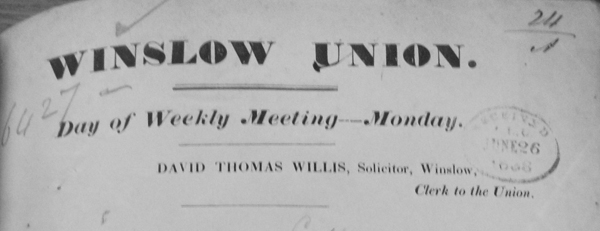
Letterhead used for later correspondence with the Poor Law Commission
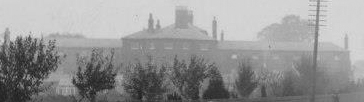
The new Workhouse had a master's house designed by George Gilbert Scott, and capacity for 250 inmates. See Board of Guardians for more information about the building. It catered for a union of 17 parishes extending to North Marston, Stewkley and Shenley, with a very small population compared to the other Poor Law unions in Bucks. It was run by a master and matron. Peter Griffiths was temporary schoolmaster Oct 1840 - March 1841, and the Guardians then advertised for a master:
 1840, 9 May: Bucks Herald
The Guardians of the poor of the WINSLOW UNION wish to engage with a young Single Man as Schoolmaster for the Union Workhouse. He will be required to reside constantly in the house, (where he will be provided with board and lodging) to instruct the boys in reading, writing, and the principles of the Christian religion, and to assist the Master of the Workhouse in the performance of his duties, and in the maintenance of order and due subordination in the house.
Testimonials to character and competency will be required.
Candidates for the situation are requested to attend the Board of Guardians at their weekly meeting, to be held at the Union Workhouse, in Winslow, on Monday, the 18th of May instant, at Ten o’Clock in the forenoon, or, previously thereto, to send testimonials with specimens of writing, to Mr. DAVID THOMAS WILLIS, Solicitor, Winslow, the Clerk to the Union.
Winslow, 4th May, 1840.
1841: census return for Winslow Workhouse
Thomas Willietts was Master and his wife, Frances was Matron. He died in January 1842, aged 38.
Hannah McDaniel the teenage schoolmistress (appointed Oct 1840) was replaced in 1842 when there was an advert for "a SCHOOLMISTRESS (without incumbrance) for the female children", to teach "reading, writing, arithmetic, the principles of the Christian religion, knitting and plain needle work" (Northampton Mercury, 30 July 1842).
The establishment of the Winslow Union led to a dispute between the constituent parishes about how much they should contribute:
1841, 13 Feb: Bucks Herald
The rating of the Winslow Union Workhouse, which caused so much commotion amongst the Guardians of the neighbouring parishes in which the Union stands, is, we are happy to hear, at length amicably arranged.
1841, 3 April: Bucks Herald
The amount of assessment of the Workhouse, of the Winslow Union, which has so long been in agitation with that and the other parishes of the Union, has now every appearance of speedily being brought to a decision, by the appointment of two competent persons to arbitrate between the conflicting parties.
1841, 7 Aug: Bucks Herald
WINSLOW
The amount of assessment on the new workhouse in this union, still continues to furnish matter for contention. The parishioners, desirous of pacific measures, have propounded a proposition to the other parishes by which they are willing to make a great concession on the sum originally levied; but the inflexible tenacity of position taken up by the latter, appears to leave no alternative than an appeal to judicial proceedings.
There was also a dispute about the auditor:
1845, 27 Nov: Bath Chronicle
POOR LAW UNION AUDITORS. – The Queen v. Willis. – In the Bail Court on Monday, the Attorney-General applied on behalf of the Poor Law Commissioners, for a mandamus commanding David Thomas Willis, clerk to the guardians of the Winslow (Bucks) Union, to produce the accounts of the union. It would appear that an auditor had been appointed for auditing the accounts of the Winslow Union, and there was another union called the Buckingham Union, of which two unions a person of the name of Cowley had been appointed auditor. The Poor Law Commissioners had subsequently directed that 19 unions should be incorporated, including Bucks and Winslow, and over all these a Mr. Haward was appointed auditor by the commissioners; but the guardians of the Winslow Union had refused to produce their accounts. The question therefore was, whether the commissioners had this power. Mr. Justice Patteson said it was proper to be considered, and therefore he granted the rule.
National Archives, MH12/514 no.1: proposal to use Poor Law funds for streetlights and pumps, 1843
Winslow 9th Jan(ua)ry 1843
To the Poor Law Commissioners
Somerset House, London
Gentlemen,
I am directed by the Board of Guardians of the Winslow Union to inform you that an intimation has been made to them of a wish on the part of some of the inhabitants of Winslow that part of the amount invested in the name of the Guardians as the surplus of the proceeds arising from the sale of the property belonging to the parish of Winslow may be appropriated in the purchase of some iron lamp posts for the purpose of lighting the streets of Winslow. The inhabitants have adopted the provisions of the lighting and watching acts, and the recent formation of a Gas Company in the town has rendered the providing of lamp posts for the public lights a necessary step on the part of the parish. The object of my present communication is to enquire whether you consider the above a proper mode of appropriating
the sale proceeds. I have every reason to believe that there is also a wish to appropriate a further portion to the erection of some pumps for the use of the public.The Guardians will be much obliged by your favoring [sic] them with your opinion on the above points at your earliest convenience.
Dav Tho Willis [signature]
Clerk to the Union
The Commissioners asked for more information.
27th Jan(ua)ry 1843
… the provisions of the General lighting and watching act have been adopted for the whole parish of Winslow cum Shipton, and that in the event of your sanctioning the appropriation of part of the sale proceeds to the providing of lamp posts and pumps, the application of the proceeds to these purposes would no doubt be entrusted to the Police Inspectors and the posts and pumps provided would become parish property …
14th Feb(rua)ry 1843: response from Poor Law Commission Office
… the main object of the proposed application, viz the providing of lamp posts, is one which in my opinion falls within the provisions of the act 3rd & 4th Wm 4th cap 90 sec 45. I do not think that the supply of pumps is an object which can be provided for out of the lighting and watching rate. I am not aware that there is a probability of the application applying to any other objects than the purchase of lamps and supply pumps …
11th March 1843
Sir,
I am directed by the Poor Law Commissioners to acknowledge the receipt of your Letter of the 14th Ult on the subject of an application of a part of the Winslow sale produce to the providing of Lamp \Posts/ & Pumps for the use of the town & to state that as the former can be supplied by a rate already in existence the Com(missione)rs cannot consistently with their usual general practice sanction the applic(ati)on to that purpose. They \are/ however ready to sanction the applic(ati)on of a reasonable sum to the providing of pumps upon having such a plan laid before them as will secure to the parishioners a permanent supply of water …
Winslow 27th October 1843
To The Poor Law Commissioners,
Somerset House, London
Gentlemen,
I have the honor to acknowledge the receipt of your letter of the 14th inst and to state in reply that the Inhabitants have obtained patterns for iron pump cases with different prices marked and have made enquiries as to the probable expence of leaden pumps and with these data formed an estimate of the costs likely to be incurred but they have not entered into any contracts, not feeling justified in doing so without being first satisfied that they shall have the means of paying the expence. The pumps are to be supplied with water from wells, and there is a well at each of the spots proposed for placing the pumps.
In answer to your enquiries on the subject of the lamp posts I beg to state that for several years the lighting and watching act (3rd & 4th Wm4)
has been partially adopted as far as regards watching and in Novr 1841 it was agreed to adopt its provisions as to lighting also. The Directors then provided some lamps which were suspended from the houses and lighted by oil. A gas and Coke company having since been formed it has been considered desirable to substitute the use of gas and in order to prevent a delay the Directors of the Gas Company have provided posts which have been erected and the lamps belonging to the parish have been made use of but the Inhabitants consider it objectionable that the posts should be treated as the property of the Gas Company and the lamps as the property of the parish; and that it would be much better that the whole should belong to the latter.
The amount authorised to be raised during the current year for the purpose of watching and lighting is Eighty seven pounds which is barely sufficient and I think there would be a difficulty in obtaining a sufficient augmentation of that sum to enable the Watching Committee to purchase the lamp posts …
Dav Thos Willis [signature]
Clerk to the Committee
[Minutes of the Vestry appended. The Commissioners replied that they could not sanction the expenditure on "gaslight posts". The Guardians also applied to spend some of the money on assisting emigration to Australia.]
National Archives, MH12/514 no.6: report on Workhouse, 1843
Cheltenham 1st April 1843
Gentlemen,
I return herewith Form A of Winslow Union, relating to the maximum amount of accommodation in the Union Workhouse.
I visited Winslow on Thursday the 23rd instant for the purpose of inspecting the Workhouse in reference to this question; and I have now to report that I cannot fully agree with the return sent by the Guardians and signed by their Medical officers.
My opinion is that if the various classes of inmates were in exact proportion to the quantity of room \provision made for them/ in their several departments, the house could not properly accommodate more than 250 inmates; and in this opinion I am confirmed by the Master of the Workhouse, who stated to me at the same time his opinion that on the above supposition of a proper proportion of each class, the house might receive 250 without being over-crowded.
The greatest number in the House at one time during the last winter was about 230; and some of the classes exceeding the proportion
of numbers provided for arrangements were obliged to be made for their reception in the wards belonging to other classes.
I recommend that the maximum number be fixed at 250
A.
Power [signature]
[separate note in another hand]
Fix the number at 250 persons and state the reasons of the Com(missione)rs for Charity for limiting the W.H. to that number as noted in Mr Power’s report.
[printed forms with handwritten answers]
List of queries |
||
| No.1. Number of married Paupers in the Union Workhouse, on the 30th of March, 1843, who have been in such Workhouse for a longer period than five years? | None | |
| 2. Number of such Paupers being over 50 years of age? | 2 | These numbers are applicable to the paupers who have been in the workhouse less than 3 years |
| 3. Number of such Paupers being under 50 years of age? | 14 | |
| 4. Number of such Paupers who may be considered able-bodied men? | 7 | |
| 5. Number of married Paupers in the Union Workhouse, on the 30th of March, 1843, who have been in such Workhouse for a period less than five years? | 16 | |
| 6. Number of such Paupers who have been admitted more than once? | 14 | |
| 7. Number of times each of such Paupers has been admitted? | One 11 times – Five 4 times - One Three times – Eight twice | |
| 8. State when your Workhouse was first opened for the Reception of Paupers? | 1st November 1836 | |
| 9. Number of married Male Paupers that have died in The Union Workhouse since the passing of the Poor Law Amendment Act? | 1 | |
| 10. Number of married Female Paupers that have died in The Union Workhouse since the passing of the Poor Law Amendment Act? | 8 | |
| Signed this 3rd day of June 1843. Dav Thos Willis [signature] Clerk to the Board of Guardians | ||
| 1. State the name of the Person appointed Schoolmaster at the Workhouse | George Tredaway |
| 2. His Place of Residence immediately previous to his Appointment | Assistant Schoolmaster & Porter in the Winslow Workhouse during the illness of Charles Dancer Schoolmaster & Porter |
| 3. His Age | Twenty Six |
| 4. Whether Married or Single | Married |
| 5. State his Religious Persuasion | Church of England |
| 6. State his Previous Occupation, Profession or Calling | Schoolmaster Servant at a Gentleman’s family* |
| Whether he has been in the Army, Navy, Excise, Police, or other Public Service, and if so, which service, the cause
of his leaving the same, and the period since which he so left |
No |
| Whether he has kept a Public House, and if so, when? | No |
| Whether he has before held parochial office, and what | No |
| 7. Has he been the officer of any and what Union? and if so, state the cause of his leaving that situation, and the period since which he left | No |
8. Has he ever been Bankrupt or Insolvent? And if so When? |
No |
| 9. Is his whole time given up to the service of the Union? or, does he continue in any previous occupation, profession or calling? | Yes |
| 10. State the date from which his Duties commence? | From the date of his appointment 28th August 1843 |
| 11. State the Amount of Salary proposed | Twenty pounds a year |
| Are any Rations or other Emolument allowed, and what | The usual rations and beer |
| 12. Are the Guardians satisfied by his Testimonials or
otherwise that he is competent to fulfil the Office of the Schoolmaster of the Workhouse, and to perform efficiently the duties required by the Regulations of the Commissioners? |
Yes |
| 13. State the Cause of the Vacancy on account of which the appointment is made: if a Resignation, state the Cause of such Resignation | Death of Charles Dancer the late Schoolmaster & Porter |
| Dav Thos Willis | Signature of the Clerk |
| George Tredaway | Signature of the Officer appointed |
| [5 Sep 1843] | |
*In the 1841 Census he and his wife were servants to Philip Dauncey of Little Horwood.
The Workhouse provided the only public medical facility in Winslow, and people who were not inmates are recorded as dying there.
Poisoned pregnant girl dies in Winslow Workhouse (by Ed Grimsdale, information from Northampton Mercury)In 1845, Ann Ray was the only female attendant in the house of farmer Duncombe. Francis Fleet was a shepherd working on that farm in Dunton. Those working on the farm had gossiped that Francis was having an affair with Ann. On 26 June, Fleet had been working all morning with other men in the rickyard and told them at 1pm that he was going into the house to get bread and cheese from “the gal”. In fact, he gave her some “corrosive sublimate” or mercury (II) chloride, a deadly poison used on sheep. Although reluctant to drink the mixture of mercury chloride and water that Fleet had mixed, Ann relented under pressure from him. She fell violently ill immediately and suffered terrible agonies. Ann stated that she was two months pregnant by Francis Fleet and that he had tried to get rid of her pregnancy, without success, on an earlier occasion. Fleet was arrested after a rag containing the poison was found on his person. Ann Ray was transferred by gig from Dunton to Winslow Workhouse on 9 July 1845. She grew rapidly worse, an ulcer burst, and Ann died in the Workhouse from “exhaustion” on 21 July.
The jury at Fleet’s trial during Aylesbury’s Assizes in March 1846 found Fleet guilty of murder through administering a poison to effect abortion. Judge Baron Parke put on the black cap and sentenced Francis Fleet to death. The jury begged the judge to show mercy as Francis had not meant to kill Ann, and he had showed concern over her suffering. The judge said he would communicate their concerns to the proper quarters, but he did not hold out any prospect of mercy in this life.
Board of Guardians, 18 May 1846 (Centre for Bucks Studies, G6/1/3)
The Poor Law Commissioners having suggested the inmates of the workhouse should be put on different sides (the women at present using the yard originally intended for the men in consequence of its contiguity to the public road) ordered that the request be attended to and a chimney and grate be put for a nursery on the western side.
Board of Guardians, 13 Nov 1848
The Clerk was directed to summon an extraordinary meeting of the Guardians to be held next Monday to take into consideration the propriety of lighting the workhouse by Gas.
20 Nov 1848
It having been proposed to light the workhouse by Gas, the proposition was rejected in a division, there being for the proposition 3, against it 13.
A proposition having been made to provide a carpet for the master's sitting room, the same was rejected on a division, there being for the proposition 7, against it 9.
23 April 1849
Ordered that the women who wash in the house be allowed some bread and cheese.
National Archives, MH12/515 no.24: complaint by paupers, 1849
[The letter below is given in its original form apart from some added spaces and capitalisation.]
Winslow April 22 1849
Gentlemen of the Poor Law Comishaners
I rite to infor you the treatment whe receive in Winslow Union I Henry Rodwell have made severel complaints concearning our food but to no avail so gentelemen hi thoutht it proper to rite a few lines to you I myself asked for permision to go into the garding for hair [I] have been hill but I was collared and [?tak]en back again by the master of the workhouse our yard is very small a litle more then five feet of ground and there is a privey on one corner and if whe turn the hother way towards the house thare is the closet winders hopen so thare is no fresh hair that whe can get and that causes a deal of sickness our children are shut up in in thair yard and school for munths togeather the wiming are locked in the wash house during the day from mundy morning till Saturday night
[p.2] And the are not alowed no fresh air at all except going of a harand for the mistres not from one years end to the hother whe ave four half pints of what they call hail but it is water spilt that is all whe get for our work their is one por man bed riten wich as had severel fresh paupers to atend im but tha man that loocks after him now declared to me that the bead was quite rotten under neath[?] and the poor man was in a deplorabele state to make c[omplai]nt to the board it is to no par[pose?] as whe have [?a] magistrate sitting at tha [?board] for more than a hear and half James Will[ett ?said I] wish to have my case stated concearning the treatment I received I came into the workhouse hill caused for the want of food and ob[…] I have and six children and when I am not habel to work aney longer I am admitted into the house and my wife and family left at their missarable home my too holdest dauchters have been sent to the gravilpits to dig gravil and my wife to out doars work wich as caused hur to miscarry twice I went on Monday 16th of April and asked for a pair of shoes and a litle
[p.3]
clothing as I told them all I ad on wen I went out was not worth six pence and I could not go out to work and reply was no tha would not give me anny but I was to go out and I refused going as the wages was only eight shillings pur week and eight to maintain I have our rent to pay three pounds a hear firing to by soap out of eight shillings a week I resisted going to be starved with honger and cold the master sent for the purlice oficer and took me down and locked me up all night I was taken before a magistrate and I was to go home to my starving family or go to prison so I went home that is our usage from our poor law gardents that sit at our board at Winslow bucks one poor pauper lost three children in five week and I myself have lost one and I believe it is for the want of more hair so no more at preasent from your humble and obedent sarvant Henry Rodwel pauper Winslow Union Bucks
Joseph Timpson [signature]
Fredrick Higins [signature]
Richard Ward [signature]
[comments by Mr G. Pigott the Poor Law inspector]
No reliance can be placed on these statements. I believe the paupers in this workhouse are treated w(i)th much care & mildness and the workhouse itself is airy and commodious. But is the usual course to send a copy if sent a letter to the G(uar)d(ia)ns that they may reply to the charges therein. GP
24 April 49
[reply to Poor Law Board by the Guardians]
Winslow 5th May 1849
My Lord and Gentlemen,
I am directed by the Board of Guardians to acknowledge the receipt of you letter inclosing Copy of a letter addressed to you with the signatures of Henry Rodwell and others. Two of the men whose names are affixed to that letter (Joseph Timpson and Richard Ward) having at their own request attended before the Board at their last meeting for the purpose of making application to quit the house, stated to the Board that they had no complaint to make and on Ward’s attention being called to the letter he informed the Board that he had never read the letter or heard it read and that his name was not added to it by himself though there is reason to suppose from his manner that he authorized its being signed. James Willett’s name does not appear to the letter and in fact he had left the house before it was written so that it does not appear necessary to trouble you with any remarks upon his case. With regard to him and in every other respect the letter is full of mis statements and there is no reason to doubt that it is the production of Henry Rodwell who has for years been the cause of a great deal of trouble to the Guardians and their officers both as an in and out pauper. While out of the house he was a very active
[p.2]
agent in favor of Mr Feargus O’Connor land scheme and in his residence in the house he has found the means of getting the Northern Star newspaper clandestinely conveyed to him in spite of the Guardians forbidding that it should be allowed. He has been for some time using every effort to promote insubordination in the house and has so far succeeded [that] on two successive days after the writing of the letter to [you] but before the copy of it had been received by me, the Master of the house found it necessary to apply to the Magistrates for protection and on the second application Rodwell was committed for 21 days to the House of Correction at Aylesbury where he is now confined. [During] his commitment the discipline of the house has been maintained and the inmates are perfectly satisfied : that they would have been so but for Rodwell there can be no doubt, he having told the policeman who took him to Prison that he was the cause of all the Complaints and that there would otherwise have been none. I am particularly requested by the Board of Guardians to inform you that the Men’s Yard (stated in Rodwell’s letter to contain little more than 5 foot of ground) is almost triangular the length of the sides being respectively about 24, 19 & 18 yards - some weeks since scarlet [fever] appeared among the children in the house and several of the weakliest of them died - it has now quite dis[appeared?]
[p.3] and with that exception the house has been upon the whole in a healthy state due precautions being taken to keep it as well ventilated and the yard as free from impure air as practicable. It is not thought necessary to trouble you with remarks upon any other part of Rodwell’s letter but if there are any other points on which you require further information the Guardians will be most ready to give you it.
I have the honor to remain
My Lord & Gentlemen
Your very obed(ien)t & humble servant
DavThoWillis [signature]
Clerk to the Union
[further comments by Pigott]
I visited this workhouse yesterday Rodwell is still in Aylesbury gaol, but his wife and children were in the House and he is to return thither today I have no doubt that the Statement of the Clerk (corroborated to me by the Master of the WH) is in all respects corretc. Rodwell’s wife complained to me that she was not allowed to go to a meeting house on Sundays being a Dissenter. I explained to her that it re(s)ted with the G(uardia)ns to concede or refuse this privilege She had misconducted herself the preceding Sunday - with reference to this question – I beg to refer to my report of this
day [signature] 19 May 49
More on Henry Rodwell. The Northern Star was a Chartist newspaper, and this is the first evidence of possible Chartist activity at Winslow. James Willett was living at Shenley in 1851, Joseph Timpson and Richard Ward at North Marston, and Frederick Higgins at Granborough.
National Archives, MH12/515 no.24/2: appointment of schoolmistress, 1849
Winslow 23rd July 1849
My Lord and Gentlemen,
I have the honor to inform you that the Board of Guardians have appointed Martha Anne Bromley to the office of schoolmistress in the Union workhouse vacant by the resignation of Emma Collings at a salary of fifteen pounds a year with the usual rations, and to request your sanction to that appointment
I have the honor to remain, My Lords & Gentlemen
Your very obed(ien)t Serv(an)t
DavThoWillis [signature] Clerk
Winslow Union APPOINTMENT OF SCHOOLMISTRESS [printed pro forma, answers shown in italics]
1. State the name of the Person appointed Schoolmistress Martha Anne Bromley
at the Workhouse
2. Her Place of Residence immediately previous to his Aylesbury, Bucks
Appointment
3. Her Age Twenty One
4. Whether Married or Single Single
5. State her Religious Persuasion Church of England
6. State her Previous Occupation, Profession or Calling Schoolmistress
7. Whether she had any Experience in Teaching, or any Schoolmistress in Leighton Buzzard
Training for it: and if so, what Workhouse two years and three quarters
8.
Whether she has before held any Paid Office in any other Schoolmistress as above
Union or Parish: and if so, and what Office and in what
Union or Parish?
The cause of her leaving the same Her Father’s leaving the Situation of Master in the same Workhouse
And the date when she left April 1847
9. Is her whole time given up to the service of the Union? Yes
10. State the date from which his Duties commence? 7th June 1849
11. Whether she is to reside in the Workhouse? Yes
12. The Amount of Salary proposed Fifteen pounds
Are any Rations or other Emolument allowed, and what The usual rations
13. State what Testimonials the Guardians have received Testimonial from the Guardians
and whether they are satisfied thereby, or otherwise, that Leighton Buzzard Union and a
she is competent to fulfil the Office of the Office of discharge of the duties for the
Schoolmistress of the Workhouse, and to perform work during probation
efficiently the Duties required by Articles 114 and 212 of
the Consolidated General Order
14. State the Cause of the Vacancy on account of which Resignation of Emma Collings
the appointment is made: if a Resignation, state the Cause who has since emigrated
of such Resignation and the name of the former Officer
Dav Thos Willis Signature of the Clerk
Martha Anne Bromley Signature of the Officer appointed
Reported to the Poor Law Board for their approval 27th day of July 1849
Inspection of Workhouse schoolmaster [printed pro forma, answers shown in italics]
The Committee of Council on Education have considered the report of Josua Ruddock Esq., H.M. Inspecter of Parochial Union Schools, respecting your Examination before him on 29th day of May 1849, and have caused the paper which you wrote on that occasion to be reviewed.
Their Lordships’ estimate of your qualifications is stated below
Qualifications as shewn by the Papers
Religious knowledge Moderate; Improvement required
Spelling Good
Penmanship Fair
Arithmetic Good
Grammar
History
Geography
Qualifications as reported by H.M. Inspector
Reading Fair
Industrial Skill
Skill as a teacher Moderate; Improvement required
State of School Fair
Their Lordships have not been furnished with any means of judging your proficiency in those subjects of the foregoing to which no qualifying word is added
The Class of Certificate, which conformably with their Lordships’ Masters, the Committee of Council on Education have awarded to you a Certificate of Probation, Second Division and the sum showed on your behalf to the Guardians from the Parliamentary Grant, according to the scale recommended in their Lordships’ minute of the 18th December 1847, would be £25 – 0 – 0
I have the honor to be your obedient servant
(signed) Harry Chester For Assistant Secretary
Mr George Treadaway
Master of the Winslow Parochial Union School
National Archives, MH12/515 no.24/2: another complaint by paupers, 1850
[The letter below is given in its original form apart from some added spaces and full stops. It is clearly in the same hand as the complaint of 1849, i.e. Henry Rodwell's. The ends of some lines have been lost where the letter was bound into the book of correspondence.]
Winslow Union March 13th 1850
Gentlemen comishiners whe took the hopertunity of righting a few lines to you and I thought it our duty in doing so and lying our case before you[.] whe have been confined in a small yard for months to gether from thirty to forty men our yard consists of betwixt six and seven poles of ground but our number is not so great now but during the winter and whe have complained to the gargents for more are and to remove one of the wals but to no avail but the old wall being shatered it fell down and whe was in hopes of having the privilige of the other small yard but whe are not allowed it only [a] few yards of it as tha are comencing geting the fowndation out this morning 13th for [?]building the wall[.] I think it my duty to inform you [verso]
the distance from our is about boby door is ap[…] about aleven yards and the same direct[?] is over the wall ware our privey manure [is] all put is four and twenty yards from th[ere?] eight yards from the door is a sespool in the […] and seven yards is the clossit window open[ing?] into our yard and twenty yards is another […] from the door in the other yard and twenty five yards from our door is a privey and too […] with pigs food in them[.] so gentelemen whe [are] surownded with smells in every direction and [the] sespoles always stand full as thear is no proper inclosed shewers to take it away[.] so gentlemen I ope gentelemen you will grant is the privi[lege?] of both yards[.] I myself am in for want of a dw[elling?] and a litle invatary but gentlemen our way[?] is[?] very low[.] one of our inmates wished to have is [……] he as a wife and seven children six of them under [..] is wagis are 7s per week he as one shilling rent [one] shilling and three pence firing soap and candils [….] lot be necisaries one shilling leaving 3s 9d to find clothing and necasaries of life so whe are spat[?] [on and?] called lasey people[.] hoo can live and work for such [wages?]
So we remain your umbel and obadient servants
[signatures]
Thomas Walter
William Norman
Robert Bukm
Winslow 25th March 1850
My Lords and Gentlemen,
I have this day laid before the Board of Guardians your letter of the 19th inst. 10.711/50 with the copy of a letter addressed to you by Thomas Walter, William Norman and Robert Buckingham, three of the most troublesome inmates of their Workhouse. In reply I am directed by the Guardians to state there is no ground for the men’s complaint in regard to smells &c. that the “shattered” wall to which they allude was a newly built ‘solid’ wall, and was as there is no reason to doubt secretly loosened by the mortar being picked out, and then pushed down by some of the paupers, and that the Guardians then availed themselves of acting on the recommendation of your Inspector Mr Piggott that the men’s yard should be enlarged by building up the wall again at the place suggested by him.
Additional comments by Grenville Pigott the inspector:
The former yard for the men is too small.
I had pointed this out to the G(uar)d(ia)ns on[?] two[?] occasions[?]
If Relayed as I recommended it will
be sufficient. In other respects the statement
of the Clerk may be depended upon Except
that I am of opinion that the drains of
the house are defective. I will take an
early opportunity of seeing the G(uar)d(ia)ns
GP 3rd May 50
National Archives, MH12/515 no.24/2: the scandal of James Spicer the master
1850, April [undated]: Extract from Mr Pigott’s Report
There are now thirty able men in the Workhouse, an unprecedented number at this season of the year for this small rural union the farmers having in some parishes dismissed many of their usual Labourers. The Master of the Workhouse has been removed from the House by the Medical Officer who informed me that he was suffering under “Alcoholic Mania” and required not only quiet but close watching also – and on enquiry I find that for some time past he has been \constantly/ in a state bordering upon drunkenness. There will be a special Meeting of the Board of Guardians on Thursday next which Meeting I propose to attend for I do not think the Union or
Workhouse in a satisfactory state. I presume that the Poor Law Board will not sanction the continuance of the Master in his office – indeed the Matron who is his sister and the Schoolmaster, a very respectable and intelligent man have both stated that for some time past the habits of the Master have rendered it impracticable for them duly to perform their own duties. In the present state of mind of the Master however I do not advise dismissal and will report again to the Poor Law Board after the Meeting on Thursday.
1850: Board of Guardians minutes, 2 May
Mr Pigott having reported to the Board that since the last Meeting he had appointed George Tredaway, the Schoolmaster and Porter of the Workhouse to perform the duties of the master of the house till the present meeting in consequence of the absence and illness of James Spicer, the master, and the Clerk having informed the Board that Spicer had [p.51] Since sent to him his resignation of the office, the Board appointed George Tredaway to continue temporarily the duties of master, and directed the Clerk to notify the same and the vacancy in the Office to the Poor Law Board.
It was resolved to postpone for the present the consideration of the subjects for considering which it was at the last meeting resolved that the present should be an extraordinary meeting.
Resolved that the meeting be adjourned to tomorrow at ten o’clock to take into further consideration the circumstances attending the Master’s resignation.
1850: D.T. Willis to the Poor Law Commissioners, 2 May
I am directed by the Board of Guardians to inform you that the office of Master of the Workhouse of the union is vacant in consequence of the resignation of James Spicer, which followed the temporary substitution on Saturday last by your Inspector, George Grenville Piggott Esq, of the Schoolmaster of the Union House in his place. Spicer has absconded and in consequence of information given on oath this day before an ex officio Guardian of the Union a warrant has been issued for his apprehension on a charge of forgery. The Guardians have this day confirmed George Tredaway the Schoolmaster, temporarily subject to your sanction, and as they have some doubts how far other officers of the establishment have been mixed up in the transactions which have led to Spicer’s resignation, they have resolved to meet again tomorrow to enquire \into/ the case, and for these
reasons they request that for the present they may not be required to make a permanent appointment. Mr Piggott attended the meeting of the Guardians this day.
1850: Board of Guardians minutes, 3 May
Resolved that it is the opinion of the Board on a further investigation of the circumstances in relation to the late master, that as his absences from the house have been perpetual and as those absences have been known by the Matron but concealed known by the person officiating as Porter and Schoolmaster and not only concealed but entries made in the Porter’s book utterly at variance with the truth it would be for the benefit of the Union that a change altogether should take place as regards these offices and that subject to the approval of the Poor Law Board a master and matron should now be advertised for.
The Board of Guardians are fully aware that the dismissal of any Officer rests with the Poor law Board but they feel it would be best to have a man and his wife as master and matron.
The Board of Guardians feel unable to proceed as to the removal at present of the Porter and Schoolmaster because he is the only party they have to manage at this moment the conduct of the house.
… Thomas Saving was temporarily engaged to act as porter and assist the Schoolmaster at the Workhouse.
Resolved that the meeting be adjourned to Tuesday next 14th May at eleven o’clock.
1850: D.T. Willis to the Poor Law Commissioners, 3 May
I am directed by the Board of Guardians to inform you that they have this day held an adjourned meeting to enquire into the circumstances attending the resignation of the late Master of the Union workhouse and having found by the examination of Mrs Willetts the Matron that it was the master’s habit to be out of the house for considerable intervals, that during last week he was absent from Thursday afternoon till Friday evening, and on the previous Wednesday he went out in the morning and did not return until night, that he was absent a great part of several days in the previous week, and that for almost a twelvemonth except on board days he has been in the house to attend to his duties but very little, that she repeatedly remonstrated with him and begged of him if he could not fulfil his situation to resign and leave with “credit”, and that from his repeated absence she considered he must be drinking; and having found on referring to the Porter’s book that although since the commencement of the present year 24 entries were made as to the … [next page not photographed]
1850: report by G.G. Pigott to the Poor Law Commissioners, 3 May
In accordance with the intimation given in my report on the Winslow Workhouse and on the misconduct & sickness of the Master, on the 27th ult(imo), I attended a special meeting of the Board of Guardians yesterday, at which almost every Guardian was present.
The Clerk laid before the Guardians a letter from the master signifying his resignation of his office, and informed them at the same time that the Master had quitted the town of Winslow & that his present place of abode was not known.
Upon further investigation it appeared probable that he had been guilty of extensive frauds upon the Union and amongst others that he had forged a cheque for £50 which was given him in blank by the Clerk for the signature of the Coal Merchant, together with a cheque for payment upon the Treasurer. The Coal Merchant was examined by me & stated that he had not been paid & that the signature of his name to the receipt was not \in/ his handwriting.
Under these circumstances a Warrant has been granted for the arrest of the Master and a Committee of the Guardians appointed for the further immediate investigation of his accounts, which however have only recently been passed by the District Auditor.
It appears that the average cost of food and Clothing of each Pauper inmate of the Workhouse for the halfyear ending 25th March has been no less than 3/9 per head; an excessive Sum nearly the double of the cost in some Workhouses. The cost of the Clothing has been 2d per week which is four times the usual amount.
I will take care that these points are fully looked into, and have recommended the Guardians (until it is ascertained how far the Matron and Porter may have been cognisant of the system of Waste or fraud practised in this Workhouse) not to advertise for a new Master of the Workhouse but to provide for its management temporarily.
The present Matron is the Widow of \a former/ Master & Sister of Mr Spicer who has just resigned his Office.
I regret to add that the Workhouse is now full in the able men’s Department. The Small Farmers, who are numerous in this District, have turned off almost all their labourers or so greatly reduced their wages that they are not sufficient to sustain a large family. Amongst other admissions to the Workhouse yesterday, was that of a man, his Wife & 7 Children, the eldest 13 years, the youngest 6 weeks, who had thrown up his employment at 7/s a week as insufficient to support nine persons. He was a powerful man and good labourer 34 years of age.
At the present average cost of the maintenance of the inmates of this Workhouse, 3/9 per head Weekly, the Weekly charge to the Parish for this family (in idleness) will be 33s/9d per week whereas for nine shillings per week the poor man would rejoice to maintain them by his labour.
I represented this in vain to the Guardians and report it now simply for the information of the Poor Law Board, for it is plain that interference w(oul)d avail nothing & that the evil must work its own remedy.
1850: notes by G.G. Pigott, 5 May
I beg to refer to my special report on this subject
subsequently to the meeting of the G(uardian)s of the 2nd inst
I think the view taken by the G(uardian)s correct and that the
Matron & the Porter (the latter especially) have no longer
claim to their confidence & ought therefore to be removed
from their offices since the G(uardian)s require it. The better
course for the officers in question to take would be to resign
but before they are called upon to do so they are entitled
to have a communication of the charges against them
with an opportunity of explanation Copies therefore of
the Clerk’s letter s(houl)d be sent to them. They have hitherto
except in this instance been exemplary officers.
Subject to their explanations, the application
of the G(uardian)s may be sanctioned. I have engagements
for next week wh(ich) will not admit of my attending the meeting \of the G(uardian)s/ on Thursday
next but if they as a Committee will meet me on the Monday
or Tuesday following at 12 o’clock the 13th or 14th time will then
have been given to receive the replies of the officers inculpated & to come to
some conclusion.
[note in margin dated 6 May] Write to these officers for explanations as requested, and inform the G(uardian)s
1850: letter from George Tredaway, Schoolmaster & Porter, Union Workhouse, to the Poor Law Commissioners, 9 May
I beg most respectfully to acknowledge the receipt of yours of the 7th current. I would gladly have answered it by yesterday’s post but today being the meeting of the Guardians I thought it advisable to lay your letter before them as I had not been questioned on any subject whatever, nor did I correctly understand the tenor of their letter.
My Lords and Gentlemen, for your information respecting my conduct in connection with the charges against the Master I beg to hand you the following remarks & earnestly hope they will be satisfactory -
I have been employed as Schoolmaster & Porter in this Union for a period of seven years & upwards - during the whole of that time the Guardians have never once intimated to me that they were in any way dissatisfied with my conduct and in the Visitor Book the report respecting the schools have generally been satisfactory, altho’ not so to myself for I feel confident that two such offices cannot be done justice to by one person as the duties greatly interfere with each other so that neither can be correctly performed.
There are two entries to the House[,] one totally away from where the Schoolmaster and Porter would be likely to be, to the other entrance the Master has a key so that he was enabled to go out or come in whenever he pleased at either gate without any of ones knowledge – there is no Porter’s Lodge, or sitting room for the Schoolmaster so that after school hours he has no private room but his bedroom - with these statements I trust My Lords will rest satisfied[?] that it is not possible correct entries can be made in the Porter’s Book and that what I have therein stated is not all at variance with truth.
An adjourned meeting of the Guardians is appointed for Tuesday the 14th inst(ant) by which time I trust to be exonerated from the charges brought against me.
1850: letter from Fanny Willetts, Matron, Union Workhouse, to the Poor Law Commissioners, 9 May
I cannot but acknowledge myself in fault in concealing the little I knew of my brothers late misconduct. The only reason of my not reporting him was his promising to attend properly to his duties for the future. I thought as a sister I ought to give him a fair chance trial he however did not fulfil his promise and I determined on reporting him the following Board-day but the Assistant Poor Law Commissioner coming previous to the Guardians Meeting I at once communicated to him all I knew of my brothers conduct. The fact of my having exposed the conduct of my brother immediately upon the arrival of Mr Piggot will I trust be a sufficient guarantee that it was only the feelings of an attached sister towards her \own/ brother that kept me so long silent earnestly [?I ask] your sympathy.
1850: Board of Guardians minutes, 14 May
Mr Pigott as Inspector made enquiry into the conduct of Mrs Willetts the Matron and George Tredaway the Schoolmaster and Porter as connected with the late irregularities of James Spicer the master, and they both sent in resignation of their Offices. They both agreed temporarily to hold the same for six weeks.
The Clerk was directed to advertise in the Times, Oxford Journal and Northampton Herald for a master and matron at fifty pounds a year, a Schoolmaster at twenty pounds and a porter at ten pounds
1850: Board of Guardians minutes, 1 Aug
The Clerk produced a letter from Mrs Spicer as to the delivery of some articles left in the house by her husband. Resolved that the same be detained for the present.
The Clerk ... was directed to write to Messrs Scaldwell & Maffey the sureties of James Spicer and request their attendance at the next meeting of the board and also to inform Messrs Hearn & Nelson thereof
1850: Board of Guardians minutes, 5 Sep
George Tredaway having sent a letter to the board wishing to leave his situation as Schoolmaster it was agreed he should quit on Thursday 19th inst.
The Clerk submitted a draft of a letter to the Poor Law Board as to Peter Fisher’s claim for coals & on other matters in relation to James Spicer the late Master which was approved
1850: Board of Guardians minutes, 19 Sep
The Clerk was directed to sign a certificate of the general good character and conduct of George Tredaway as Schoolmaster, and that he quitted on his own resignation.
1850, 30 Nov: Bucks Herald: Winslow Special Petty Session, 25 Nov
James Spicer, late master of the Winslow Union Workhouse, was brought up in custody of Mr R. Ossitt, high constable of Winslow, charged with having on the 18th of April, 1850, at Winslow, feloniously offered, uttered, and disposed of a certain receipt, purporting to be given by one Peter Fisher, to the Guardians of Winslow Union, for £57 10s., with intend to defraud the Guardians, knowing the same to be forged.
D.T. Willis Esq., Clerk to the Union, on oath proved – That at a meeting of the Guardians in December last he, as clerk, issued an order for Peter Fisher to deliver 50 tons of coals at the Workhouse. That the order was delivered to James Spicer with other orders then issued. That James Spicer debited himself in his books with receiving 50 tons of coals. At a meeting held at the Board, February 4, Spicer produced a bill, written by himself, for the 50 tons of coals, as being due to Peter Fisher. The bill was allowed and marked by the Chairman, and a cheque for the amount drawn at the time on the Treasurer of the Union. Witness proved the Union vouchers; the bill and receipt signed “Peter Fisher.” That Spicer called at his office, either on the 29th or 30th of April, and afterwards sent a written resignation of his office, and left Winslow about the 1st of May. That till Spicer left, witness had no doubt of the genuine character of the receipt. On May 2, in consequence of information received, he, as Clerk to the Magistrates, filled up a warrant for prisoner’s apprehension, which was signed by a Magistrate, and delivered for execution to a police officer.
Benjamin Cole, clerk to Mr. Willis, stated – That he remembered Spicer calling at Mr. Willis’s office on the 4th of February, after the Board had broken up, and asked for Fisher’s cheque. That he wrote a stamped receipt for the amount, and delivered the receipt, bill, and cheque to the prisoner. That the receipt was then unsigned, and he gave it to Spicer to get it signed by Fisher. That Spicer afterwards delivered to him the bill and receipt, the latter being then signed “Peter Fisher.”
Mr. John King, treasurer of the Union, produced a cheque for £57 10s., payable to Peter Fisher, or bearer, drawn by the Guardians of the Union, and dated February 4, 1850. He received the cheque from Spicer on the 7th of February last, and gave him the amount.
Peter Fisher said he had supplied coals to the Union for the last six years. That he delivered coals at various times from Nov. 30, 1849, to April 27, 1850 – sixty tons at the Workhouse. That he had examined the receipt for £57 10s., dated Feb. 4, then produced. That he did not sign it, nor authorise any person to sign it on his account. The signature I swear is not in my hand-writing. In consequence of information he had received, that Spicer had left the Union, he came to Winslow and went to Spicer’s house to ask him for the money for the coals he delivered at the Workhouse. Spicer said he had not it. Not being satisfied, witness went again, and threatened to go to one of the Guardians and ask him for the money. Spicer said, “If you do I am a ruined man, for I have received the money, and paid it away all but £15;” and he offered to pay me that sum, and get a bond from his father-in-law for the remainder. This witness refused.
Prisoner on being asked if he wished to say anything, said he should reserve his defence for a future occasion. He was then fully committed to take his trial at the next Assizes at Aylesbury for the county of Buckingham.
1850, 14 December: Bucks Herald
Buckinghamshire and Northamptonshire Audit District. Winslow Union.
I, the undersigned Alfred Hayward, Auditor of the above named District, do hereby give Notice, that I shall hold my Audit of the Accounts of the Winslow Union, and of the several parishes and places therein, and of the officers thereof, for the half-year ended on the 29th Day of September, 1850, to commence on Monday, the15th Day of December 1850, at Eleven o’Clock in the Forenoon at the Board Room of the Workhouse of the Union aforesaid; when and where all Persons who by law are bound to account at such Audit, are required to attend and to submit all Books, Documents, Bills and Vouchers containing or relating to their accounts or to monies assessed for and applicable to the Relief of the Poor.
Dated this 2nd Day of December, 1850. Alfred Hayward.
1851: D.T. Willis to Poor Law Board, 18 Jan (TNA, MH12/515)
[The Guardians] have not at present taken any steps against Spicer's sureties for recovery of the sum of £25-5-3.
... The above sum is the value of provisions found to be deficient, and forms only a part of the late Master's defalcations. ... Spicer is in Aylesbury Gaol awaiting his trial ... [Poor Law Board advised them to take prompt action (29 Jan) and enquired what action had been taken (15 March)]
1851: Board of Guardians minutes, 30 Jan
The Clerk laid before the Board a document shewing the expenses of James Spicer, late Master of the Workhouse, and he was directed to write to Messrs Charles Scaldwell and Charles Maffey, Spicer’s sureties and require payment of £90 – 11 – 7 the balance, before the next Meeting of the Board
1851: D.T. Willis to Charles Scaldwell and Charles Maffey
I am directed by the Board of Guardians of Winslow Union to inform you that on an examination of the books and accounts of James Spicer the late Master of the Union Workhouse the balance due from him to the Union after setting off some small payments made by him and deducting the amount of his salary up to the time of his removal is £90 – 11 – 7. This sum I am to require you as his Sureties to pay to me before the next meeting of the Board which will take place on Thursday 6th February at Ten o’clock. I am instructed to request your particular attention hereto as unless the money be so paid the Guardians will be compelled to commence proceedings at once upon your Bond as they have received peremptory instructions from the Poor Law Board to take prompt measures for the purpose of obtaining payment of the amount of the deficiencies from you and not allow the matter to delay any longer.
1851: Board of Guardians minutes, 6 Feb
Messrs Scaldwell and Maffey (the Sureties for James Spicer the late Master) attended before the Board and requested the Guardians to delay proceeding to enforce payment of James Spicer’s defalcations until the former had communicated with the Poor Law Board on the subject and had obtained their reply when he promised to write to the Board of Guardians This request was complied with
1851: Charles Maffey, Dunstable, to Poor Law Board, 14 March
My Lords and Gentlemen,
I beg to lay before you the following statement in the hope that it may be in your power to protect me from what I conceive to be an act of injustice with which I am threatened by the Board of Guardians of Winslow Union.
In the year 1842 I rented an Inn [The Rose & Crown] at Winslow under Mr Willis the Clerk of the Winslow Union and then became joint surety with Mr Scaldwell of Winslow for Mr James Spicer then Master of the Workhouse of the Winslow Union.
After a lapse of about 2½ years circumstances compelled me to give up my business and I afterwards obtained employment as a Constable in the Beds Rural Police the duties of which Office I continued to fill until the year 1848 when I obtained the Appointment of Relieving Officer of the Dunstable District of the Luton Union at a Salary of £80 per annum.
In the year 1850 I received a Letter from the Winslow Union dated the 1st of August, a copy of which is enclosed herewith.
I attended the meeting of that Board on the day appointed, hoping to hear the particulars of the defalcations of Mr Spicer when I was informed that the Guardians were unable to give me the information.
Upon this I made some enquiry amongst the Inhabitants of the Town of Winslow on the subject and was informed that the principal item of the charge consisted of the misappropriation of a Cheque for about £70 entrusted to him by the Clerk of the Union for the purpose of paying a Coal Merchant for Coals supplied to the Union, a Trust which I apprehend ought not have been reposed in him, and the breach whereof his sureties cannot be called upon to answer. And that the remainder arose from some alleged deficiency in the stores of the Workhouse.
I also learned that Spicer had for some time latterly been habitually drunk and on one occasion was found lying in the street at Winslow very drunk with Cheques of the Guardians to a considerable amount in his Pocket, and these circumstances were well known to the Guardians.
I never had any intimation from the Guardians on the subject of my Bond or of Spicer’s misconduct until I received the Letter above referred to nor have I received any communication from them since that time until I received the Letter dated 31st January 1851, a copy of which is enclosed, wherein I am called upon to make a payment of £90 – 11 – 7, the amount of Spicer’s defalcation, without any account of the items thereof.
Knowing that I had not the means of meeting the demand, having nothing but my Household Furniture and my Annual Salary of £80 as Relieving Officer which barely enables me to support myself and family consisting of a Wife and 3 Children I consulted the Clerk of the Luton Union upon my situation and through his kindness Mr Williamson of Luton, Solicitor, wrote a Letter to the Guardians of the Winslow Union, a copy of which is enclosed, and I afterwards attended a Meeting of the Winslow Board on Thursday Feb(rua)ry 6th when the Guardians informed me that they must proceed against me in compliance with the directions of the Poor Law Board.
When I left Winslow I was not aware that I could get released from my Bond and therefore took no steps for that purpose but I beg to submit to you that the Clerk of the Winslow
Union having been my Landlord at Winslow and my Goods having been sold there by Auction the Guardians must have been fully aware of my inability to perform my engagement with them.
I beg to add that in the event of the Guardians proceeding against me I must inevitably be ruined as I have no means wherewith to defend myself at Law.
Under all these circumstances I trust you will excuse my troubling you with this appeal to you, as the head of the Department under which I serve, for the purpose of obtaining such assistance and protection as it may be in your power to afford me.
1851, 15 March: Bucks Herald
James Spicer, carpenter and joiner, was indicted for having on the 18th day of April last, at the parish of Winslow, uttered, disposed of and put off a certain receipt, purporting to be given by Peter Fisher to the Guardians of the Poor of the Winslow Union, for the sum of fifty-seven pounds and ten shillings, with intent to defraud the said Guardians.
Mr. Wells conducted the case for the prosecution, and Mr Power for the prisoner.
David Thomas Willis – Am clerk to the Winslow Union. Know the prisoner. Mr Peter Fisher was our coal merchant. The Board of Guardians issued an order for some coals, which I gave to Spicer. Saw Fisher on the 2nd of May. I produce a bill, which I received from the prisoner. Showed Mr. Fisher the paper. There was a warrant issued for the apprehension of the prisoner, who had absconded. Some time afterwards he surrendered to a friend of his, who received the reward offered.
Peter Fisher – Am a coal merchant. Sent 60 tons of coal to the Union, on the 31st of January. Applied to the prisoner for payment in the latter end of April. Showed this paper to the board of Guardians It is not my handwriting. At that time £70 10s. was due to me.
Cross-examined – Have dealt with the Board six years. Have received my money through Spicer, who used to get it from Mr. Willis for me. Always signed the receipt myself.
Benjamin Coles, clerk to Mr. Willis, deposed to giving Spicer the check and receipt, which he received back from him.
Mr. King, treasurer to the Union, received the check from the prisoner, which he cashed.
Verdict – Guilty. Sentence – Two years’ hard labour, on hearing which the prisoner fell down insensible in the dock with great violence.
Note that in the above report Spicer's position as Master is not mentioned. In the 1851 census James Spicer was in Aylesbury Gaol, where he was recorded as a carpenter & joiner aged 30, born at St Albans.
1851: Board of Guardians minutes, 20 March
The Clerk read two letters received from the poor law board with copy of a letter addressed to them by Charles Maffey as to James Spicer’s defalcations – The Clerk was instructed to answer the letter received dated yesterday
1851: D.T. Willis to Poor Law Board, 20 March
...
When Mr. Maffey first attended the Guardians in August last, the exact extent of Spicer’s defalcations had not been ascertained. So soon as it was ascertained, Mr Maffey and his Co-Surety were informed, and on their attending at the Guardians meeting a statement in writing of the deficiencies, and of sums to be credited to Mr Spicer, was produced to them, from which Mr Maffey took some extracts, and he was told that he was at full liberty to inspect any of the master’s books. Mr Maffey’s statement as to Spicer being found lying in the street at Winslow very drunk with cheques of the Guardians to a considerable amount in his pocket was the first intimation to me or any of the Guardians then present as to such an occurrence, as Mr Maffey was expressly told by the Guardians in their Board room, and I have not heard nor can I learn from any of the Guardians by whom Spicer was seen in the situation referred to. As I at the same time told Mr Maffey I never saw Spicer drunk, and if what Mr Maffey states be correct it is surprising that Mr Scaldwell, his Cosurety, who resided in Winslow, should not have noted it and reported it.
I cannot clearly see for what purpose Mr Maffey has introduced into his letter the fact that he was my tenant, unless for the sake of raising an inference that as his Landlord I used some influence with him to become Spicer’s surety. That however I did not do; his becoming surety was, as far as I was concerned, a voluntary act of his own, and I believe I had no communication with him on the subject till he called [sic] to execute the bond. His leaving my house was also voluntary on his part, and so was the sale of his effects. The Auditors from time to time inquired in the usual way as to the existence and circumstances of the sureties, and the Guardians had no reason to be dissatisfied with Mr Maffey’s security.
1851: Poor Law Board to Charles Maffey, 9 April (draft)
I am directed by the Poor Law Board to transmit to you herewith a copy of a letter which they have received from the g(uar)d(ia)ns of the Winslow union on the subject of the claim made by them upon you as one of the sureties of James Spicer late Master of the Winslow Union W.H. for the amount of that officer’s defalcations, & in reference thereto to state that the B(oar)d do not see that they have any power to interfere in the matter, - It does not appear to them, so far as they can
Judge from the facts before them that there is any grounds upon which it \you/ can be held to be legally released from the obligation which you entered into with the g(uar)d(ia)ns of the Winslow Union as James Spicer’s surety.
1851: Board of Guardians minutes, 17 April
Mr Charles Scaldwell one of James Spicer’s Sureties having attended the Board and requested time for payment of the amount of his defalcations it was resolved that on payment of ten pounds on account at or before the Meeting of the Guardians on 15th May application be made to the Poor Law Board to allow the remainder to be paid by equal instalments at Midsummer, Michaelmas, Christmas and Lady day next. The Clerk was instructed to write to the Sureties to that effect.
1851: Board of Guardians minutes, 15 May
The Clerk reported that he had received of Charles Scaldwell one of James Spicer’s sureties five pounds on account of that officer’s defalcations, and he was instructed to write to the Poor Law Board and state that the Guardians intended, if it meet their approval, at once to sue Charles Maffey the other surety upon his bond but to delay proceedings against Mr Scaldwell for the present
1851: Board of Guardians minutes, 2 Oct
Ordered that the sum of £5 received from Charles Scaldwell one of the sureties of James Spicer be paid to the Treasurer, debited to him and credited to James Spicer.
The Clerk was directed to write to Charles Scaldwell and require him to state his intentions as to the payment of the balance of James Spicer’s deficiencies by the next meeting.
1851: Board of Guardians minutes, 16 Oct
Mr Charles Scaldwell attended the Board and was allowed till the next meeting to state what his proposals were as to his liabilities as one of James Spicer’s sureties.
1851: Board of Guardians minutes, 23 Oct
Charles Scaldwell attended the Board and made a further payment of £6 6s on account of James Spicer’s deficiencies and the Board resolved to defer proceedings against him till this day fortnight
1851: Board of Guardians minutes, 7 Nov
The Clerk was instructed to continue proceedings against Charles Maffey as one of James Spicer’s sureties for recovery of the latter’s defalcations.
1852: Board of Guardians minutes, 5 Feb
The Clerk having read a letter received by him from Messrs Williamson and Austin Attornies [sic] to Charles Maffey, offering to pay half the amount claimed from him and Charles Scaldwell, as sureties for James Spices, with the costs of the action commenced against him by instalments of four pounds a quarter, it was resolved, subject to the approval of the Poor Law Board, to accept Mr Maffey’s offer on having a judgement or Judge’s order.
1852: Board of Guardians minutes, 1 April
The Clerk having received of Charles Scaldwell the several sums of £6-6, £5, £5 & £5, together £21-6 \on account of James Spicer’s deficiencies/ ordered that same be paid to treasurer debited to him and credited to James Spicer.
1852: Board of Guardians minutes, 20 May
It appearing that the total of James Spicer’s deficiencies (after deducting all sums due by the Union to him) was £90 – 11 – 6 of which the sum of £25 – 5 – 3 has already been debited to him and credited to previous account in the ledger. Ordered that the sum of £65 – 6 – 3 being the balance of such deficiencies be debited to James Spicer and credited to Common charges in the ledger.
Ordered that the sum of £4 received by the Clerk last month of Charles Maffey one of James Spicer’s sureties be paid to the treasurer.
1853: Board of Guardians minutes, 21 July
It appearing by the treasurer’s book that Charles Maffey one of James Spicer’s sureties had paid £2 same to be debited to treasurer and credited to Jame Spicer.
1854: Board of Guardians minutes, 2 Feb
It appearing by the treasurer’s book that he had received of Charles Maffey £4 on further account of James Spicer’s deficiencies same to be credited to James Spicer and debited to treasurer
1854: Board of Guardians minutes, 3 Aug
A letter addressed to the Board by Charles Maffey requesting them not to press for immediate payment of the sum of £2 arrear from him as one of James Spicer’s sureties having been seen the Clerk was directed to inform him that the same must be remitted with the next instalment when it became due
1854: Board of Guardians minutes, 19 Oct
It appearing by the treasurer’s book that he had received the following same sums to be debited to him and credited as under
James Spicer cash returned of Charles Maffey £4
The next master of the Workhouse was William Vincer Minter, appointed in 1850, who served until 1894, assisted successively by two wives and several of his children.
National Archives, MH12/515 no.24/2
1850: D.T. Willis to the Poor Law Commissioners, 20 June
I have the honor to inform you that the Board of Guardians have this day, subject to your approval, appointed William Minter (now Porter to the St Lukes Workhouse, Chelsea) and his Wife Master and Matron, and John Hill of Aylesbury to be porter to the Workhouse of this Union.
I beg leave to add at the suggestion of G. Grenville Pigott Esq, your Inspector that he was present at the meeting when the above appointments were made.
1850: Printed pro forma; answers in D.T. Willis’ hand shown in italics, 6 July
Winslow Union
APPOINTMENT OFMASTER
1. STATE the Christian Name and Surname of the Person William Minter
appointed as Master of the Workhouse, in full
2. His Place of Residence immediately previous to his St Luke’s Workhouse, Chelsea
Appointment
3. His Age Thirty four
4. Whether Married, and has any, and what Married, and has no children Children dependent upon him
5. His Religious Persuasion Church of England
6. His Previous Occupations, Professions or Callings Soldier afterwards Porter of Braintree Union, then Superintendent of Laborers at the Strand Union and late Porter at Chelsea Workhouse
Whether he has been in the Army, Navy, Excise, Police, Army
or other Public Services; and if so, what Service
The cause of his leaving the same …….. Purchased his discharge
And the date he left ……… 21st October 1846
7. State whether he has ever been Bankrupt or Insolvent No
8. State whether he has before held any Paid Office in any See reply to 6th Question
other Union or Parish: and if so, and what Office and in what
Union or Parish?
The cause of his leaving the same Resigned
And the date when he left Left Chelsea in consequence of the present Appointment
9. State whether he has a competent knowledge of Accounts Yes
10. Whether his whole time is given up to the service of the Union? Yes
11. State the date from which his Duties commence 6th July 1850
12. The Amount of Salary proposed Fifty pounds for Master and [Matron]
[…] and amount of Security One hundred pounds
The Names and Addresses of Sureties John Minter, 44 Oakley Road Lambeth. Van proprietor Coal merchant &c
James Box 2 Lambeth Walk Corn dealer
State the amount of Rations or other Allowances Three rations for the Master and Matron
13. State what Testimonials the Guardians have received Testimonial from the Chairman
and whether they are satisfied thereby, or otherwise, that of the Braintree Union, the Clerk
he is competent to fulfil the Office of Master of the of the Strand Union and the Master
Workhouse, and to perform all the duties which are of the Chelsea Workhouse besides
Essential to the proper management of the Workhouse many others
14. State the Cause of the Vacancy on account of which On account of the resignation of
the appointment is made: if a Resignation, state the Cause James Spicer the former master
of such Resignation and the name of the former Officer
Dav Thos Willis Signature of the Clerk
William Minter Signature of the Officer appointed
1850: note written on reverse of the letter of 20 June, 10 July
William Minter and wife appointed Schoolmaster and Schoolmistress at Braintree 1847 resigned their offices Dec 1848 Cause_ disagreement among the officers
Appointed Superintendent of Labor at the Strand Union May 1849 and resigned July 1849 on being app(ointe)d Sub Warder to Portland Prison.
Appointed Porter at Chelsea Jan 1850 Resignation not yet reported.
[In different hand] Write to Chelsea for information.
Mr Minter did not run the Workhouse in the way you might expect, as this account from the Northampton Mercury of 1 Sep 1855 shows:
TREAT FOR THE INMATES OF THE UNION – On the 25th. ult., the inmates of the Winslow Union Poor House were treated to an excursion by rail to Buckingham, where a field had been kindly granted by Mr. Parrott, banker of that town. A day’s diversion was had in the meadow. Swings were erected for the juveniles, and the adults had a game at cricket. On the sward an excellent repast was partaken of. Later in the day the weather became unfavourable, and the company retired to the large room of the Yeomanry barracks, where tea, cake, &c., was freely supplied. The happy party returned home by the last train, grateful to their friends who had treated them. To meet the expenses, the guardians had entered into a subscription. Such of the inmates as were unable to go to Buckingham were regaled in the house.
1851, April: Inspector's report [printed questions in italics]
REPORT of Mr Piggott INSPECTOR of POOR LAWS on the above Union, after visit on the third day of April 1851
Is the Workhouse adequate to the Wants of the Union, in respect of the size and internal arrangements?
It has hitherto proved so - Its internal arrangements have been much improved by the present master
Is the provision for the sick and infectious cases sufficient? Are the receiving wards in a proper state?
There are sick wards which have hitherto proved sufficient. A Fireplace has been placed in the receiving ward – on my suggestion.
Is the Workhouse School well managed?
It is tolerably well managed, but the number of children in the School is at times so small that the Guardians proposed a resolution this day to petition the Poor Law Board to allow of the Boys & Girls being taught together under one Schoolmistress & to dispense with the Schoolmaster.
Have all appointments of new officers, and changes in salaries and districts since your last visit been reported to the Commissioners?
The Schoolmistress and the Porter have sent in their resignations
D.T. Willis to Poor Law Board, 31 Oct 1851
I am directed by the Board of Guardians to acknowledge the receipt your letter of the 29th inst. 41513/51 and to inform you in reply that they were induced to propose an alteration in the hour for the inmates of the workhouse retiring to rest during the winter half year in consequence of a representation from the master that there is a difficulty in preventing the male inmates from climbing over the walls and doing other mischief during dark evenings and that in his opinion the discipline of the house would be better maintained if the inmates went to bed at seven o’clock in winter.
[notes on letter]
I attended the B(oar)d of G(uardia)ns Meeting this day. They had reconsidered this question at their last meeting and are now of opinion that the proper[?] hour is that recommended in the consolidated order viz 8 P.M.
GP [Grenville Pigott]
5 Nov(embe)r 51
1851, November: Inspector's report [printed questions in italics]
REPORT of Mr Pigott INSPECTOR of POOR LAWS on the above Union, after Visit on the sixth day of November 1851
Is the Workhouse adequate to the wants of the Union, in respect of size and internal arrangements?It has proved so hitherto in both respects.
Is the provision for the sick and infectious cases sufficient? Are the receiving wards in a proper state?
There is no separate Hospital but the sick wards have hitherto been sufficient.
Is the Workhouse School well managed?
The total number of Children between 7 & 15 now in this workhouse is only 7. The total number of Children who attend School is 17 of whom 10 under 7. These are all instructed together with the sanction of the Poor Law Board by one teacher a Schoolmistress.
Are there vagrant wards in the Workhouse, and are they sufficient? Are the arrangements for setting the vagrants to work, and is the resolution of the Guardians under 5 & 6 Vict., e. 57, Sec. 5, duly observed.
Yes. Vagrants apply very rarely in this Workhouse – there is employment for the ablebodied.
Does the visiting committee regularly inspect the workhouse? Do any of their answers to the queries in the Workhouse regulations suggest the propriety of any interference on the part of the Commissioners?
The Workhouse is inspected from time to time.
Have all appointments of new officers and changes in salaries and districts since your last visit been reported to the Commissioners?
A new Schoolmistress has been appointed who appears to be fit for her office.
Do the Vaccinators deliver to the Clerk their Books on the day next before each day of meeting of the Guardians, in accordance with the terms of their Contract?
No – the books are kept in the prescribed form but not[?] given in at each meeting
Has any marked change taken place in the state of the Workhouse, the number of the inmates, or the general condition of the Union, since your last visit?
The labouring population of this purely rural Union is still generally employed – out of a population of nearly 10,000 – the whole number of inmates in the WH this day is 47 of whom only one male in the ablebodied Class and 3[?] females
The total number this day 47
Number corresponding day of 1850 92
45
These are the residents of the Union Workhouse in the 1851 census, transcribed by the Buckinghamshire Family History Society. Please note that the alphabetical order is rather loose.
Winslow Workhouse 1851 |
||||
| Name | Age |
Occupation | Place of birth | |
| William Minter | Mar | 31 |
Master of Workhouse | Margate Kent |
| Mary Ann Minter | Mar | 26 |
Matron of Workhouse | Southwark Surrey |
| Frederick Meads | Unm | 17 |
Schoolmaster of Workhouse | Box Moor Hertford |
| John Hill | Unm | 26 |
Porter of Workhouse | Stony Stratford |
| James Ash | Wid | 54 |
Pauper Ag. Lab. | Swanbourne |
| Robert Ash | Unm | 15 |
Pauper Scholar | Swanbourne |
| Jane Ash | Unm | 12 |
Pauper Scholar | Swanbourne |
| Joseph Brown | Wid | 70 |
Pauper Tailor | London Middlesex |
| John Bates | Unm | 64 |
Pauper Ag.Lab. | Drayton Parslow |
| Alice Burt | Unm | 73 |
Pauper Lace Maker | Great Horwood |
| Joseph Clark | Unm | 87 |
Pauper Ag.Lab. | North Marston |
| Jemima Chetwood | Wid | 42 |
Domestic Servant | Richmond Surrey |
| William Eeeles | Wid | 67 |
Formerly Farmer Pauper | Cranwell Waddesdon |
| William Faulkner | Unm | 48 |
Pauper Ag.Lab. | Whaddon |
| Harry Fareman | Unm | 14 |
Pauper Scholar | Little Horwood |
| Ambrose Fareman | Unm | 9 |
Pauper Scholar | Little Horwood |
| Thomas Goodger | Wid | 73 |
Pauper formerly Ag.Lab. | Winslow |
| John Grace | Wid | 72 |
Pauper formerly Ag.Lab. | Whaddon |
| William Gilks | Mar | 32 |
Pauper Ag.Lab. | Granborough |
| Elizabeth Gilks | Mar | 24 |
Pauper Lace Maker | Mursley |
| Catherine Gilks | 4 |
Pauper Scholar | Granborough | |
| Mary Gilks | 1 |
Pauper | Granborough | |
| William Gibbs | 8 |
Pauper Scholar | Little Horwood | |
| Titus Hurst | Unm | 82 |
Pauper formerly Ag.Lab. | Mursley |
| Elizabeth Edens | Unm | 71 |
Pauper Lace Maker | Winslow |
| Catherine Hurst | Wid | 86 |
Pauper Lace Maker | Stony Stratford |
| Thomas Hurst | Unm | 16 |
Pauper Ag.Lab. | Mursley |
| Joseph Hogston | 12 |
Pauper Scholar | Dunton | |
| Jesse Hall | 10 |
Pauper Scholar | Great Horwood | |
| Daniel Hall | 13 |
Pauper Scholar | Great Horwood | |
| George Illing | Wid | 72 |
Pauper Ag.Lab. | Little Horwood |
| Elizabeth Illing | Unm | 22 |
Pauper Lace Maker | Little Horwood |
| Joseph Illing | 9m |
Pauper | Little Horwood | |
| James McLellen | Wid | 42 |
Pauper f'ly Attorney's Clerk | Paisley Renfrew |
| Robert McLellen | 9 |
Pauper Scholar | Glasgow Lanark | |
| John Lambourn | Unm | 60 |
Pauper Ag.Lab. | North Marston |
| William Ludgate | Unm | 68 |
Pauper Ag.Lab. | Swanbourne |
| Elizabeth Linny | Wid | 33 |
Pauper Lace Maker | Westcot |
| Elizabeth Labrum | Mar | 32 |
Pauper Lace Maker | Mursley |
| Mary Labrum | 12 |
Pauper Scholar | Mursley | |
| George Labrum | 10 |
Pauper Scholar | Stewkley | |
| Thomas Labrum | 7 |
Pauper Scholar | Stewkley | |
| Jane Labrum | 4 |
Pauper Scholar | Simpson | |
| John Labrum | 1 |
Pauper Scholar | Simpson | |
| Henry Linney | Unm | 15 |
Pauper Scholar | North Marston |
| Robert Linney | 13 |
Pauper Scholar | North Marston | |
| Thomas Lambourn | Unm | 16 |
Pauper Ag.Lab. | North Marston |
| John Lake | Mar | 36 |
Pauper Ag.Lab. | Stewkley |
| Mary Lake | Mar | 33 |
Pauper Lace Maker | Sherington |
| Henry Lake | 8 |
Pauper Scholar | Sherington | |
| Edwin Lake | 4 |
Pauper Scholar | Newport Pagnell | |
| Mark Norris | Wid | 72 |
Pauper formerly Baker | Winslow |
| Elizabeth Noxon | 8 |
Pauper Scholar | Stewkley | |
| William Noxon | Mar | 38 |
Pauper Ag.Lab. | Stewkley |
| Ann Noxon | Mar | 37 |
Pauper Plaiter | Stewkley |
| Ann Noxon | 10 |
Pauper Scholar | Stewkley | |
| Martha Noxon | 7 |
Pauper Scholar | Stewkley | |
| William Noxon | 4 |
Pauper Scholar | Stewkley | |
| George Noxon | 1 |
Pauper | Stewkley | |
| Catherine Norman | Unm | 55 |
Pauper Lace Maker | East Claydon |
| Lydia Norman | Unm | 18 |
Pauper Domestic Servant | East Claydon |
| William Norman | Unm | 16 |
Ag.Lab. | East Claydon |
| Sarah Norman | Unm | 16 |
Pauper Lace Maker | Granborough |
| Eliza Pitkin | M | 32 |
Pauper Domestic Servant | Stewkley |
| Eliza Pitkin | 12 |
Pauper Scholar | Granborough | |
| John Pitkin | 8 |
Pauper Scholar | Mursley | |
| William Pitkin | 5 |
Pauper Scholar | Mursley | |
| William Payne | 12 |
Pauper Scholar | Little Horwood | |
| William Radwell | Wid | 83 |
Pauper formely Weaver | East Claydon |
| William Ratlage | Unm | 63 |
Pauper formerly Shepherd | Stewkley |
| Caroline Reynolds | Unm | 12 |
Pauper Scholar | Little Horwood |
| Thomas Sharp | Wid | 58 |
Pauper Ag.Lab. | Dunton |
| George Smith | Unm | 21 |
Pauper Ag.Lab. | Winslow |
| Mary Smith | Wid | 79 |
Pauper Soldier's Widow | Fritwell Oxon |
| Charles Spooner | Unm | 37 |
Pauper Ag.Lab. | Drayton Parslow |
| Eliza Vickers | Unm | 29 |
Pauper Lace Maker | Great Horwood |
| Thomas Vicker | 2 |
Pauper Scholar | Newport Pagnell | |
| Matthew Warr | Unm | 48 |
Pauper Ag. Lab. | North Marston |
| James Walker | Unm | 38 |
Pauper Ag. Lab. | Winslow |
| Caroline Walker | Unm | 29 |
Pauper Lace Maker | Winslow |
| Georgiana Walker | 5 |
Pauper Scholar | Winslow | |
| Selenda Walker | 2 |
Pauper Scholar | Winslow | |
| John Bradbury | Unm | 67 |
Pauper Ag. Lab. | Mursley |
1851: Problems with schoolmaster and -mistress
National Archives MH/12/515
15th April 1851
MADAM,
THE Committee of Council on Education have considered the Report of J. Ruddock Esq. H. M. Inspector of Parochial Union Schools, respecting your examination before him on the 11th day of February, 1851, and have caused the papers which you wrote on that occasion to be reviewed.
Their Lordships’ estimate of your qualification is stated below
Qualification as shewn by the Papers.
Religious Knowledge Moderate
Spelling Good
Penmanship Fair
Arithmetic Moderate
Qualification reported by H. M. Inspector.
Reading Good
Skill as a Teacher Pretty fair
State of School Improved
The Class of Certificate which the Committee of Council on Education have awarded to you is a Certificate of Probation, Second Division, and it appears that the average number of Scholars under your care during the year preceding the date of your examination was 10. The sum therefore to be allowed to the Guardians for the Parliamentary Grant on your behalf for the current parochial year, according to the scale laid down by the Poor Law Board and the Committee of Council, will be £17 – 10 – 0
I have the honour to be,
MADAM, Your obedient servant, (Signed) R. R. W. LINGEN
To: Miss Martha A. Bromley, Mistress of the Winslow Parochial Union School
[D.T. Willis to Poor Law Board, 2 May 1851]
I am directed by the Board of Guardians to inform you in reply to your letter of 30th ult. No. 17 710.51 that Frederick Meads voluntarily resigned the office of Schoolmaster in consequence of a rumour that he had been improperly connected with a female pauper in the workhouse, which rumour the Guardians have reason to think is not unfounded.
I am also to inform you that the Guardians now find that Martha Anne Bromley late Schoolmistress and who has just been appointed to a similar office in Hitchin Union workhouse did not pay proper attention to her Scholars here and that in one particular instance a child which was under her instruction for about nine months and which does not evince any inability to
learn does not yet know her alphabet.
Under the circumstances the Guardians have delayed paying the Schoolmaster and Schoolmistress the increase of salary certified by the Committee of Council on Education and will abstain from doing so till they hear from you again.
Winslow Union
Sir John Walshams Remarks
My idea of promoting this young man’s appointment originated with Mr Tufnell and Mr Pigott himself. The Blything Board asked me to recommend a Schoolmaster I applied as I usually do on these occasions to Mr Tufnell. He spoke very well of Meads but referred me to Mr Pigott who confirmed Mr Tufnell’s report. In the meanwhile the Blything Guardians had written (by my advice) to the Cheltenham Training School and were unwilling to appoint Meads who is a younger man that they like to have, until the result of their application to Cheltenham was known. I have not heard from them since but I should not now let them appoint Meads without making them aware of what had occurred in the Winslow Union – though I do not myself think that such occurrence is of sufficient gravity to shut
him out from another trial; these peccadilloes on the part of Schoolmasters of Workhouses are becoming very frequent which fact considering their general youthfulness and the temptations to which they are exposed is not perhaps as surprising as it is embarrassing.
J.W. 4 May 51
1852: A lukewarm reference for the schoolmistress
National Archives MH/12/16249/176: Letter to the Poor Law Commissioners on Winslow Union notepaper
Winslow 18th March 25th 1852
My Lords and Gentlemen,
I am directed by the Board of Guardians to acknowledge the receipt of your letter of the 16th instt. 8410/52 respecting Miss Hannah Adams who for a short time acted as a Schoolmistress in the Winslow workhouse and to inform you in reply that they were well satisfied as to her qualifications as a Teacher and considered her fully competent for a better situation than that which she held in their Workhouse but that they deemed it advisable not to retain her in consequence of an evident reluctance on her part to teach the Children the Church Catechism and an indisposition to afford that general assistance in the management of the Workhouse independently of the actual teaching of the Children which the Guardians require at the hand of the Schoolmistress.
Before Miss Adams came to the Workhouse the Guardians were without a Schoolmaster and Schoolmistress and they resolved with the sanction of the Poor Law Board to unite the boys’ and girls’ Schools for a time under a Mistress. Miss Adams was sent down by the Home and Colonial Office on the application of the Chaplain of the Workhouse but from an early discovery of the reasons which eventually induced the Guardians to part with her they only retained her till they could meet with another Schoolmistress, in which they found considerable difficulty. She only remained at the Winslow Workhouse from May last to October.
I have the honor to remain my Lords and Gentlemen
Your very obed(ien)t. Ser(van)t
Dav Tho Wllis,
Clerk to the Union
To The Poor Law Commissioners,
Somerset House, Whitehall
London
1853: Diminution of pauperism in Bucks
Bradford Observer, 4 Aug 1853 + The Nonconformist, 3 Aug 1853
The poor-house for the Winslow Union was erected for 250 inmates It has contained 270 residents; but now, for the 17 parishes in the union, there are but 40 inmates, and there has not since March been an able-bodied pauper in the house. The expenses have decreased to a similar extent. Some of the parishes formerly paid upwards of 20s in the pound on the assessment, and now the average of the union is about 9d in the pound.
1855-56: Misconduct by inmates (BA, G6/1/5)
15 March 1855: Sarah Moxon, George Moxon and Thomas Moxon reported as disorderly. The Board approved of the Master having inflicted corporal punishment on the two latter with a stick.
17 May: John Lamburne disorderly.
31 Jan 1856: George Evans (late an inmate) and Philip Budd (an inmate) reported for wasting the property of the Union.
1860: correspondence with Poor Law Board (TNA, MH12/517)
[stamps] Received P.L.B. June 1 1860
Received P.L.B. June 5 1860
DAVID THOMAS WILLIS, Solicitor, Winslow
Clerk to the Union
Winslow 31st May 1860
My Lords and Gentlemen,
I have the honor to inform you that the Guardians at their Meeting yesterday took into consideration your letter of the 14th instant No.13483 B /1860 with reference to the proposed appointment of Mr William Minter as Relieving Officer of the Union; when they requested meeto state to you with the utmost respect and deference their strong desire that Mr Minter should hold that appointment for the whole of the Union as well as the office of Master of the Workhouse.
I am directed to add that the number of Inmates of the Workhouse has for a long time been very small and now only amounts to 39 and that the number of Out Poor receiving Relief has considerably decreased, the weekly payments in money and kind scarcely exceeding forty pounds. They have found Mr Minter a very efficient Officer and from the first formation of the Union they consider the duties of the office have never been so well attended to as they have been by him. As he has held both situations for more than three months the Guardians consider they have had a fair opportunity of judging as to the propriety of uniting the two offices and of the prospect of one officer being able to perform the whole the whole duties satisfactorily and if on this representation you should still entertain a doubt as to the propriety of making a permanent appointment, which the Guardians hope will not
be the case. \they ?trust/ you will not object to allow a further trial to be made of the present arrangement.
I am instructed by the Guardians further to state that in case they should find the duties too onerous for one Officer to perform, they would at once either appoint a temporary Assistant or make an arrangement for the election of an additional relieving officer whether Mr Minter’s appointment may be permanently or only temporarily approved by you.
I have the Honor to be
My Lords and Gentlemen
Your most obed(ien)t Servant
Dav Thos Willis [signature]
Clerk to the Union
Mr Pigott
2 June 60
I cannot advise the PLB to go beyond the concession they have already signified their readiness to make[,] being satisfied that no one man can properly attend to the outrelief of so wide a district during the Winter and at the same time give proper attention to the order & discipline of the Workhouse[.]
Moreover the precedent would be a bad one and would no doubt be followed up by similar applications from other Unions – I think that the G(uar)d(ia)ns should be told, very distinctly, that the PLB cannot go further than they have stated, but that they will sanction the temporary performance of the duty of R(elievin)g O(ffice)r by Mr Minter during the present summer until 1st Oct at the proposed salary on which day it will cease and that they request that the G(uar)d(ia)ns will report the election of a R(elievin)g Officer before that day. Either for the whole Union or for the District proposed. A similar arrangement was tried in the West ?Firle Union with less than ¼th of the Pop(ulatio)n and than ⅔rds the area of the Winslow Union with such ill result that the G(uar)d(ia)ns were glad to return to the rule laid down by the PLB - There is no other instance of these two offices being held by the same officer within my District
GP
3rd June 60
[A letter from the Poor Law Board dated 8 June states:]
The Board have had under their consideration the representations contained in your letter, but they retain the opinion that one person cannot properly attend to the out-relief during the Winter months in as extensive a District as that proposed to be assigned to Mr. Minter and at the same time give proper attention to the order and discipline of the Workhouse. The Board regret therefore that they must decline
to assent to Mr Minter being allowed to hold the offices referred to permanently.
[The remainder of the letter repeats Mr Pigott's points]
1861: Winslow Workhouse in the Census (transcribed by Glenys Warlow; PDF file of 28 KB)
1861: Returns of every adult pauper in each workhouse who has been an inmate of the workhouse during a continuous period of five years, 29 July
p.6: Winslow
Charles Spooner: 11 years: Paralysis
James Walker: 15 years: Deformity
James Wenman: 6 years: Imbecillity
1863: Inspector's report (TNA, MH12/517)
Winslow
REPORT of Mr Corbett INSPECTOR OF POOR LAWS on the above Union, after a Visit on the Twelfth day of June 1863
1. Date of last previous visit
Dec 10th 1862
2. Is the Workhouse adequate to the wants of the Union, in respect of size and internal arrangement?
It is generally adequate in both respects, except as remarked at Qu. 3.
3. Is the provision for the sick and Infectious cases sufficient?
There is no separate provision for Infectious cases.
4. Are the receiving wards in a proper State?
They are.
5. Is the Workhouse School well managed? Insert a copy of any entry in the Visiting Committee’s or other book, made since your last visit, by an Inspector of Schools.
This small School which is a mixed one, is very well managed and arranged by the Schoolmistress, who pays much attention to the individual training of the girls. I have examined the children who have acquitted themselves fairly except in writing in which they are backward. I beg leave to recommend
a dozen of Bithell’s “Spelling taught by transcribing and Dictation” price 4d Published by
Groombridge.
The floor of the Schoolroom is very damp & I beg to submit to the Guardians
whether it might well be Boarded or paved with wood which is cheaper & more durable.
H.G. Bowyer 16 March '63
6. What is the number of Inmates in the Workhouse not in communion with
The Church of England, and what
arrangements, if any, exist for affording them the religious consolation and instruction of ministers of their own separate persuasion?
Not any.
13. Is there any officer whose appointment has been sanctioned provisionally? If so, state your opinion of his fitness.
The Schoolmistress, who appears to have given great satisfaction since her appointment & to be well fitted for the situation.
16. State whether the terms of the Contract for Vaccination are
generally fulfilled, and whether there is any defect in the Vaccination
arrangements, upon which you
think it is desirable that the Board
should communicate with the
Guardians
I have no reason to think there is any neglect on the part of the Medical Officers, nor any defect in the arrangements. The Children in the Workhouse are all vaccinated.
17. Has any marked change taken place in the state of the Workhouse, the number of the inmates, or the
general condition of the Union,
since your last visit?
The Guardians have boarded the floor of the Schoolroom since Mr Bowyer’s Visit on the 16th of last MarchThe number of Inmates is 17 less than on the occasion of my last visit.
18. Observations not falling under any of the previous heads, and points (if any) upon which it is suggested that the Board should write to the Guardians
I have again drawn the attention of the Guardians in writing, to the want of any separate provision for the Infectious cases, and pointed out to them that notwithstanding the great amount of unoccupied space at present in the
Workhouse, no facility appears to exist for converting any
portion of such into wards proper for the reception of Smallpox or fever patients
Dated this 13th day of June 1863
REPORT of Richard Basil Cane. Esquire, INSPECTOR of POOR LAWS on the above Union, after Visit on the Wednesday the 15th day of February 1865
1. Date of last previous visit
18th May 1864
2. Is the Workhouse adequate to the wants of the Union, in respect of size and internal arrangements?
3.
Is the provision for the sick and infectious cases sufficient?
4.
Are the receiving wards in a proper state?
See the former Reports. There is no change in any particular calling for special remark.
5. Is the Workhouse School well managed? Insert a copy of any entry in the visiting Committee’s or other book, made since your last visit, by an Inspector of Schools.
Mr. Bowyer visited the School on the 31st of August last. The “State” of the School (which on a previous visit had been “Fair”) was then “Improved”.
“Examined the Children, who have acquitted themselves very fairly ahd have made progress under Miss Christmas. H.G. Bowyer”
6. What is the number of inmates in the Workhouse not in communion with the Church of England ... ?
None
7. Are the Provisions of the 19th Section of the Act 4 & 5 Wm. IV e 76, duly and systematically observed in the management of the Workhouse?
I believe that they are.
8. Are there vagrant wards in the Workhouse, and are they sufficient? Are the arrangements for setting the vagrants to work, and is the resolution of the Guardians under 5 & 6 Vict., e. 57, Sec. 5, duly observed.
Yes.
No Task of Work has been submitted \to/ and approved by the Poor Law Board. I have brought the subject under the notice of the Board \Guardians/ who have passed a Resolution, a copy of which will be forwarded to the Board for their approval. There are no means of warming these Wards even in the most inclement weather. There is no proper convenience for decency and cleanliness. I have called attention to these defects.
[Separate note in margin] Resolution forwarded see 6248/65 To be approved
9. Does the visiting Committee regularly inspect the Workhouse?
Yes
Do any of their answers to the queries in the Workhouse regulations suggest the propriety of any interference on the part of the Commissioners?
No
Insert a copy of any entry made since your last visit in the visiting Committee’s book, or other report book, by a Commissioner in Lunacy.
13 Dec(embe)r/64. There are now four Males and two Females of weak mind in this Workhouse. They are all employed in various ways and appear to be quite harmless. Three of the men sleep in a Room apart from the other Inmates, and I have suggested they should be placed in a Room where they would be under supervision. They appear to be properly taken care [of] and kindly treated. Their Rooms & Beds were clean & in g[ood order]
James Wilks [signature]
Commissioner
10. Has the maximum number of inmates of the Workhouse, fixed by the Commissioners, been constantly observed since your last visit?
It has
16. State whether the terms of the Contracts for Vaccination are generally fulfilled, and whether there is any defect in the Vaccination arrangements, upon which you think it is desirable that the Board should communicate with the Guardians.
The answer that I received to the enquiries that I made on this subject was satisfactory.
17. Has any marked change taken place in the state of the Workhouse, the number of the inmates, or the general condition of the Union, since your last visit?
No particular change has occurred either as regards the Indoor or Outdoor Poor
18. Observations not falling under any of the preceding heads, and points (if any) upon which it is suggested that the Board should write to the Guardians.
Nil
Enquire what [has] been done for remedying defects in the [arrange]ments in the vagrant ward to in M S{?].
JJ 21 Feb 65
R.J. Cane [signature] Poor Law Inspector
Dated this 18th day of February 1865.
REPORT of Richard Basil Cane. Esquire, INSPECTOR
of POOR LAWS on the above Union, after Visit on the Saturday the 23rd day of December 1865
5. Is the Workhouse School well managed? Insert a copy of any entry in the visiting Committee’s or other book, made since your last visit, by an Inspector of Schools.
There are 15 Children (8 Boys and 7 Girls) in the School. 6 are Industrially taught. They are under the sole charge of a schoolmistress.
The School was visited by Mr Bowyer on the 1st inst. and its “State” was considered to be “Fair”.
8. Are there vagrant wards in the Workhouse, and are they sufficient? Are the arrangements for setting the vagrants to work, and is the resolution of the Guardians under 5 & 6 Vict., e. 57, Sec. 5, duly observed.
There are sufficient Wards and the Task of Work regularly exacted. The Master speaks very highly of its effect.
9. Does the visiting Committee regularly inspect the Workhouse? I believe they do.
Do any of their answers to the queries in the Workhouse regulations suggest the propriety of any interference on the part of the Commissioners? No
Insert a copy of any entry made since your last visit in the visiting Committee’s book, or other report book, by a Commissioner in Lunacy. Nil
There are six “Weak minded” or Imbecile persons in the Workhouse at the present time. They have not been seen by a Commissioner in Lunacy since my last visit to the Union.
17. Has any marked change taken place in the state of the Workhouse, the number of the inmates, or the general condition of the Union, since your last visit?
The number in the Workhouse is very small (43) yet there were only 32 at this time last year. There also appear to be more out-door poor when the two periods are compared. This is ascribed to sickness and especially to Fever at the present time.
Observations not falling under any of the preceding heads, and points (if any) upon which it is suggested that the Board should write to the Guardians. Nil
R. Basil Cane [signature] Poor Law Inspector
Dated this 26th day of December 1865.
1868: Christmas at the Workhouse
Bucks Herald, 9 Jan 1869
At this festive season of the year, when we read of unbounded charities in every direction, we are glad to state that on Christmas-day the inmates of the workhouse were not forgotten. The Guardians had arranged for a supply of beef and plum pudding, unlimited in quantity, that those less fortunate than themselves might spend a merry Christmas. The old men and women were supplied with snuff and tobacco, and also some good foaming ale. The children and others had an allowance of nuts and oranges. The chapel of the workhouse was very tastefully decorated; on the walls were several texts well suited to the season. Mr Minter, the master, had kindly collected a sum of money from the Guardians and tradesmen, and provided a monster Christmas-tree for their amusement, the contents of which were distributed among the inmates on New Year’s Eve. The master and matron of the house, by their exertions contributed considerably towards carrying out a season of rejoicing among the inmates of Winslow Union
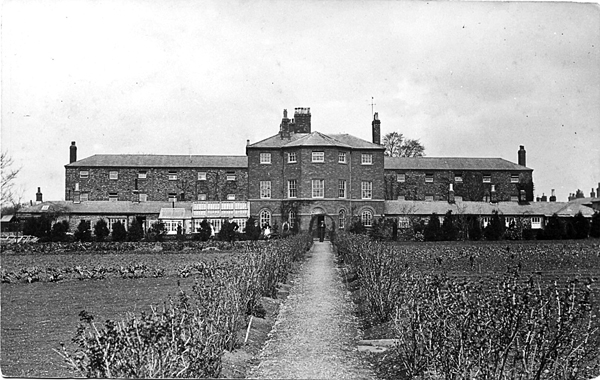
Early 20th-century view of the Workhouse from the south, with the Master's House in the centre. The large garden may have become a liability as the inmates of the workhouse increasingly became the elderly and infirm rather than the able-bodied poor. Thanks to Clive Dobbs for the photo.
1871: Winslow Workhouse in the Census (transcribed by Glenys Warlow; PDF file of 32 KB)
1872: The land of milk and honey
Introduction by Ed Grimsdale
The cold, wet years experienced in North Bucks and throughout England during the 1860s were accompanied by severe outbreaks of cattle plague – mainly rinderpest. Crops failed, and the scarcity of food increased prices. Times were hard not only for agricultural labourers but also for their masters, or employers. The labour force contracted, and that situation was exacerbated by the gradual introduction of mechanised implements, such as the steam ploughs created by Ricketts and Beard at the Castle Iron Works in Buckingham. In their desperation to avoid the ignominy of the workhouse, labourers and their families left their homes in search of work. Below is the beginning of a fascinating letter, perhaps a rant, from a farmer in Devon. What a shame that it was published in the South West. Had it been sent to the Bucks Herald, the side-effects being felt by Mr Minter and the Guardians of Winslow’s workhouse might have evaporated. The letter suggests that the Winslow Workhouse may have been a more attractive option than others in the area under the regime of Mr Minter and his family. Word of mouth may have spread the message from tramp to tramp that it was worth going an extra mile or two to enjoy the delights of the Winslow tramp ward.
Daily Western Times, 1 Nov 1872
SLAPTON
To the Editor of The Daily Western Times
Sir, - I see in your yesterday’s issue an account of the Agricultural Labourers. At the meeting of the Winslow Board of Guardians on Wednesday, Mr Minter, master of the Workhouse, stated that if the applications for admission to the tramp ward should continue as numerous as they have lately the accommodation would have to be increased. On Sunday last no less than twenty agricultural labourers were admitted, some of them accompanied by their wives and children. They stated that they had gone north in search of employment, but had been unsuccessful, and were making their way as best as they could to their native places in the southern counties, which they had left in the hope of bettering their condition. …
[The rest of the letter is about the good conditions enjoyed by the writer's own employees]
A LARGE EMPLOYER
1876: Arson at Winslow Workhouse (section by Ed Grimsdale)
The parents of James Price deserted him in London. Sometime afterwards, James became an inmate of Winslow Workhouse at the age of 13. On 26 Sep 1876, according to the Master of the House, Mr Minter, James had been given work in the Old Men’s ward alongside a smaller boy called Higgins. Hearing the sound of a fire alarm at 9.45am, the Master searched the East Ward and at its furthest end discovered the seat of the fire: six pillows, two mattresses and some beds were alight.
W. Higgins, a boy of 10 years, told Warwick Assizes that he saw Price enter the room, strike matches and put them under the mattresses. Because he was afraid of being hit by the older prisoner, Higgins didn’t tell anyone at the time. Elizabeth Marks, an inmate, and the Matron confirmed that they saw Price, out of bounds, around the East Ward before the fire started.
That was sufficient to convict James, although a statement from him had been read out denying his involvement. The Jury recommended mercy on account of Price’s age. The Judge called James “mischievous” and “wicked”. His sentence was a comparatively harsh one: a fortnight’s imprisonment to be followed by a five year term in a reformatory, but firstly he was to be given twelve strokes of the birch.
The Bucks Herald reported that when James heard the Judge ordering the flogging, he burst out crying, and was led sobbing from the dock. Later, his Lordship remitted the flogging and enlarged the term of imprisonment to three weeks so that James would be “eligible” for a reformatory.
(Incidentally, this was one of the first group of “Bucks” cases to be tried at Warwick after the introduction of the Winter Assizes Act that grouped Bucks, Beds, Northants & Warws together as Winter Assizes County no.5.)
Relative workhouse costs (from a Parliamentary Return, year to Lady Day, 1879, compiled by Ed Grimsdale)
| Buckinghamshire Union | % of Paupers | Per Capita Maintenance | ||
| Eton | 3.0 | £5 | 1s | 9.75d |
| Aylesbury | 3.5 | £6 | 19s | 1.75d |
| Newport Pagnell | 3.6 | £6 | 0s | 5.75d |
| Winslow | 3.7 | £6 | 0s | 2d |
| Amersham | 4.9 | £5 | 2s | 10.5d |
| Wycombe | 5.2 | £5 | 2s | 9.25d |
| Buckingham | 6.2 | £6 | 0s | 2.75d |
Comparative figures across the 3 Unions within Oxfordshire |
||||
| Oxford | 2.7 | £6 | 16s | 1.75d |
| Bicester | 3.2 | £5 | 1s | 7d |
| Banbury | 4.9 | £5 | 9s | 9d |
Baseline Figures (1871 Census) across England & Wales
The ratio of (workhouse) paupers to the population was 1:28 (3.5%).
Average cost per head of maintaining paupers was £5 8s 5d
(£1 = 20s ; 1s = 12d )
1881: Winslow Workhouse in the Census (transcribed by Glenys Warlow; PDF file of 32 KB)
1886: Election for Board of Guardians
1887: Election for Assistant Overseer
1887: controversy about sending children from the Workhouse to the Winslow United Schools
1891: Bucks Herald, 12 Nov: Board of Guardians
PROPOSAL TO SEND LONDON PAUPERS INTO THE COUNTRY.- The Clerk read a letter from the Edmonton Union respecting the sending of some fifty old women from their Union to workhouses in the country, where there was accommodation for them.- It was resolved that the Chairman [Henry Monk], Mr. Jas. King, and Mr. James East should meet after the receipt of further particulars, and forward terms to the Edmonton Union.- It was remarked that there was plenty of accommodation in Winslow Workhouse, if the price offered for the paupers was sufficient to meet the expenses.
1892: Buckingham Advertiser, 17 Dec
At the Winslow Board of Guardians, on Wednesday, Miss French personally attended, and pleaded on behalf of the vagrants being admitted to the Workhouse earlier [in the day] than is the case. The rules, however, are laid down by the Local Government Board, and are beyond the power of the guardians for alteration. It however, is gratifying to hear that at this Workhouse the master (Mr. Minter) has made it a rule to be lenient to the vagrants in this matter, and we notice that in “The Revelations of Mr. Commissioner Tramp of the Casual Wards,” the writer speaks of the treatment he received at the Winslow Workhouse in very favourable terms. He says “At Winslow the master and porter were exceptionally kind, and did not impose unreasonable tasks.” His remarks are the very opposite as regards some other Workhouses he visited.
Read more about the issues involved here on The Workhouse website.
1893: Buckingham Advertiser, 2 Dec
The Winslow Board of Guardians on Wednesday - it was a bye day - had only two items before them, and these were discussed with an originality of argument which must be read to be enjoyed. [There was a separate report of the meeting, not included here.] All sorts of objections were raised to the project of receiving 50 paupers from the Chelsea Union. “Should some of the paupers die who would pay the expenses of the burial?” said one. Another, “Will the Chelsea Union pay the carriage of the corpse from Winslow to London?” said another. Whilst the climax was reached with the question, “Will the Chelsea Union pay the railway fare from London to Winslow of the living paupers?”
Whilst even another query was advanced as to whether Winslow Churchyard can accommodate the dead paupers from Chelsea Union. It has been said that some of the guardians of the Winslow Board do not look far enough ahead. This cannot be said in this instance. We hope the Chelsea paupers will not see the report of the guardians, or they might object to being despatched to what they might expect, judging from the remarks of the members, was to be their death place.
As to the cost of the paupers in the Workhouse, the Committee have placed it at 8/6 per week per head, with an additional £20 per year for medical attendance. Seeing that the out-relief ranges from 1/6 to 3/- per week, it seems strange that it should be said that indoor maintenance should cost 8/6. It must assuredly be a good argument in favour of out-door relief.
In the end the Chelsea Union made other arrangements.
In 1894 there was controversy when William Vincer Minter retired as Master of the Workhouse, aged 75 and after 44 years' service, and the Board of Guardians refused to give him a gratuity. Mr Minter's retirement led to questions being asked about whether it would be more economical to close the Workhouse, and further investigation of how to find more inmates.
1894: Buckingham Advertiser, 4 Aug
WINSLOW AND ITS WORKHOUSE.
Next Wednesday, the Winslow Board of Guardians will be called together to discuss the question of the advisability of otherwise of closing their Workhouse. At the last meeting of the Board, Mr. Murray-Browne [government inspector] attended and suggested the closing of the building, mainly it appeared from his observations with the object of reducing the expenditure; but he admitted the more the subject was gone into, the less was the hope of this being achieved. It is well-known that it has been on the tapis for some time past, as to the apparently unnecessary expense in retaining the Workhouse and staff of officers. But it is one thing to talk of closing such an establishment, and another to point out how this can be satisfactorily accomplished. It is suggested that the paupers should be sent to the Workhouses in the neighbouring Unions. But here again rises the difficulty as to the provision of wards for the vagrants. That Winslow must provide such accommodation for the itinerant community is a certainty, and it is highly probable that if they billeted them at public houses or lodging houses, they would have their fair share of patronage from the tramps. Winslow will also have to retain its duties in sanitary and educational matters. At the last meeting, one or two of the members stated that instead of the Workhouse being abolished, and their duties decreased, they preferred the Workhouse being retained, and their duties enlarged, and it is almost a certainty that the decision of next Wednesday’s meeting will confirm this. It is to be hoped, however, that the question with all its pros and cons will be duly discussed, and also that the clauses of the new Local Government Act will receive full attention.
1894: Buckingham Advertiser, 11 Aug
The Winslow Board of Guardians, on Wednesday, discussed the question of the advisability or otherwise of closing the Workhouse in camera; and on re-admission of the Press the latter were informed that it had been decided to advertise for a master, matron and relieving officer.
It was afterwards stated that a motion for the closing of the Workhouse was negatived by a large majority. It appears that the salaries which are being paid are - Master £50, and relieving officer, £80, total £130; matron £30; assistant matron £16; and porter £18; total £194 or omitting the £80 for relieving officer, £114 as salaries of officials for the Workhouse, the pauper inmates of which do not muster a score, all told. Till recently, too, a schoolmistress was employed to educate some half-a-dozen children.
1895: Buckingham Advertiser, 23 Feb
There can be no two opinions as to the advantage of receiving the inmates from Bethnal Green in our Workhouse. The House was built for 250 inmates, and the number of late years have varied from about 18 to 30. 100 inmates at 8/6 a week each will be £2,210 per year, the greater part of which will find its way into the pockets of Winslow tradesmen, while the surplus will help lighten the burdens of the ratepayers.
There were also negotiations with Lambeth (discussed by Winslow RDC, 11 April).
1895: Buckingham Advertiser, 1 June
It is not long since H.M. Inspector suggested the closing of the Winslow Workhouse, and its conversion into a biscuit manufactory or something of that sort. And for sometime it has been on the tapis whether it would not be advisable to curtail the work of the Winslow Board by sending half of its in-door paupers to Buckingham Workhouse, and the other half to Leighton Buzzard.
1895: Buckingham Advertiser, 24 Aug: letter to the editor
THE VAGRANT QUESTION.
Union Workhouse, Winslow,
19th August, 1895.
SIR.- I have silently endured the lash of the Reverend Stephen Phillips’ of (Granborough) tongue, with regard to shutting up the House for nearly 12 months without even uttering a protest, but there is such a thing as “righteous indignation,” and a man cannot stand being goaded forever… It is in the interest and on behalf of the poor old inmates that I wish to speak, who are in sore tribulation and distress of mind for fear the House will be closed, and they will be distributed broad-cast here and there...
I have realised and witnessed that deep love and clinging to home amongst the poor, and the horror of being banished away from it, even if it be only from their native Workhouse.
This was brought very vividly and forcibly to my mind when it was contemplated last winter by this Board to take from the Bethnal Green Workhouse 150 inmates. A strong deputation, headed by the Chairman of the Bethnal Green Board, visited this House, and they stated publicly at a luncheon at the Bell Hotel that they were simply charmed with all they saw, and the manner in which the House was kept and managed.
In the face of this exceptionally gratifying tribute, when it came to be tested, and the Guardians of Bethnal Green called for volunteers (as they could not legally compel them to come), only a few stepped to the front; the remainder said “They had been born in Bethnal Green, brought up in Bethnal Green, and they hoped to die in Bethnal Green.” If that feeling prevailed there, I do not hesitate to affirm that the feeling would be doubly acute in this neighbourhood. Several of the poor old men and women came to me this last week with tears in their eyes, asking if the House was going to be closed. To pacify them I assured them nothing of the kind would happen; that the ratepayers and the majority of the Guardians would never stand by and see that done to suit the caprices and whims of one man. I wonder what would the Reverend Stephen Phillips think of me, were I to go over to Grandborough some Sunday morning, and say “You have not got much of a congregation; I think we may as well shut up your Church?”…
I think I should be wanting in respect and courtesy to the Board were I not to freely and candidly acknowledge that I have invariably found the Winslow Board of Guardians as a body a reasonable, kind and very feeling one, and I am sure nothing would grieve them more if they were aware of it than to think that anything was said or done to cause the poor old people pain.
I will now deal with a few facts. Last winter we had about 40 in the house; this was considerably over the average for many years, and often we had 25 and 30 tramps of a night. Let me enumerate the number we have dealt with during the past 10 months. They are as follows, viz:- Men, 2,159; women, 416; children 303; total 2,878.
Need I say this is most offensive work, and is at times attended with considerable danger as you are liable to catch all infections and loathsome diseases, besides run the risk of getting seriously assaulted, as some of these tramps are perfect desperadoes, and would think no more of kicking the life out of you, than looking at you, for what have they to lose? They have no dread of prison, for probably all of them are already ex-convicts.
For six months there were only two officers on the premises to attend to everything, whereas there used to be four- viz., master, matron, porter, and assistant matron.
I and my wife performed the duties of all these officers for the very worst six months of the year, without any assistance whatever, and I regret to say we had nearly all the poor old people ill with influenza, besides several other terrible cases of disease, two or three of whom died. During the foregoing six months the Guardians effected a saving at the rate of £54 per annum in salaries alone, without taking into consideration the extra officer’s rations saved…
I am, Sir,
Your obedient servant,
CYRUS EVANS,
Master.
1897: Buckingham Advertiser, 23 Jan
The bad name it earned some years ago still sticks to the Winslow Workhouse, in which there are so few people that the energies of the officers in doing the work of the place are severely taxed, more especially those of the matron, for whom it is necessary to engage paid female labour. This workhouse, however, is a very different place from what it was under the old regime. Then it was little better than a prison, but now it has become a place of comparative comfort and rest for most of the inmates, who are considerably better off than many of the out-door poor. The inmates are better housed, have more warmth, a good deal better food, and plenty of it. They are not even denied some of the luxuries of life, for tobacco is doled out, and (on medical order) the poor folk are allowed a glass of beer with which to drink the health of their benefactors. It is a workhouse for the officers; but for most of the inmates, very much a place of rest. If it were called “A Rest for the weary,” or a “Convalescent Home,” or “An earthly Paradise,” instead of a workhouse, it would be full. The Guardians had better change the name.
Letters then appeared in the local press, including one from the current Master Cyrus Evans, defending the reputation of Mr Minter from this implicit attack.
1897: Bucks Herald, 23 Jan
The Winslow Board of Guardians, owing to the small number of inmates in the Workhouse, have been reviving an old grievance, as it is necessary to employ outside assistance to keep the institution clean and comfortable, just the same as though its walls were full. Not long ago it was suggested that the Board should endeavour to sell the gigantic building to biscuit or other manufacturers, and erect some tramp wards on another site. This would have necessitated the sending of the paupers to the neighbouring Workhouses of Leighton, Newport, and Buckingham. Surely this would be a better and more economical arrangement. Perhaps the Winslow Guardians may have to resort to it yet.
1897: Bucks Herald, 2 Oct
The Winslow Guardians on Friday last decided (by a majority of 1) to receive 50 inmates from the Fulham workhouse. There are at present 31 inmates in the Winslow House, of whom a considerable number are children.
1898: Bucks Herald, 3 Sep: Board of Guardians
MORE INMATES.- The Chairman and Clerk of the Willesden Union attended as a deputation with a view to arranging for sending some inmates down from Willesden to the Winslow House … He and their clerk had been round and inspected the premises at Winslow and found that there was a great deal of room which would be suitable for their purpose, and he might go as far as to say he did not think there would be much difficulty about the matter, provided they could come to terms.- In reply to questions, the Chairman said they would find bedsteads and bedding for their paupers, but not clothing. As to burials, they would pay the Union rate. They would not, for their own credit, send what would be called infirmary cases.- On reference being made, it was found the terms quoted to Bethnal Green Union was 8s. 6d. per head per week; £20 for the medical-officer; and the burial fees. In reply to Mr. East, the Willesden Chairman said the earlier the arrangement could be made the better – by Michaelmas if it could be done-…Mr East moved that a committee of five be nominated to consider the matter, and instruct Mr. Willis what terms to ask. He said the house was built for 250 or 270 inmates, and he could remember when there were 200 there and no bother was made. They had heard a good deal of the repairs and alterations that would have to be done, but he had not the slightest hesitation in saying if the Master or the Matron were to report matters these things would have to be done in a month, whether for 200 inmates or 30 …
1898: Bucks Herald, 15 Oct
It is at length definitely settled that Winslow workhouse is to receive 50 Willesden inmates, and the Committee on Wednesday decided to engage several extra officers, viz., nurse, assistant matron, and cook.
1899: Buckingham Advertiser, 18 March (letter from Cyrus Evans)
Sir,- Through the kindness and hearty support of the guardians, I have been enabled to make one step towards establishing a little reading room and library for the poor old people. I have fixed on a bright little room overlooking the garden. It has recently been coloured and painted out, and made as comfortable as possible, with a neat book case in the corner, but alas! The book case is like the cage without the bird-empty ...
1899: 31 July: Letter from the Master, Cyrus Evans, to the Buckingham Advertiser, thanking the Guardians and the Flower Show Committee for providing "the poor old souls" in the Workhouse with a "splendid tea" and "a few hours’ recreation and comfort". The emphasis was clearly on the grateful poor and generous Guardians now, a long way from the original workhouse concept. Read the letter.
1899: Northampton Mercury, 27 Oct
The impropriety of paupers since the days when Oliver Twist asked for more porridge has gone to daring lengths. An extraordinary case comes from Winslow this week. Two aged recipients of relief formed an attachment, which ended in marriage. The bride was close on eighty, and the bridegroom was about seventy, and when the news of their nuptials reached the ears of the Guardians they stopped their relief, as according to their own words, they did not like the arrangement. They have since relented, however, and allowed the couple 5s 6d a week, with which to spend the rest of their connubial bliss.
Presumably this means that they were receiving outdoor relief and hadn't been sent to the Workhouse.
1900: Buckingham Express, 3 Feb
The clerk laid before the Board [of Guardians] a letter received from Mr. Noel A. Humphries, chief clerk at General Register Office at Somerset House, London, as follows:- “Sir,- I am directed by the Registrar General, with reference to the report of the registration inspector, who recently visited Winslow to request that you will call the attention of the Winslow Guardians to the very unsatisfactory provision that has been made for the Winslow District Registry Office, which is not only situate at the workhouse, and is thus obviously open to serious objection for marriage purposes, but consists of an inconveniently situated and very small room which is practically unfurnished. Under these circumstances I am to request that the Guardians will consider the desirability of making arrangements for a temporary register office free from workhouse associations, which are necessarily objectionable to those who wish to avail themselves of the statuary provisions for civil marriages at the Register Office.” There were, said the clerk, only two chairs in the room at present used, and the notice-board was placed in such a position as to be useless. The Registrar-General was dissatisfied with present arrangements, and the books were getting damaged by damp and otherwise- and it might follow that they would be required to keep these books in a chest in some occupied room. –The Rev. J. A. Andrews would like to see some improved arrangement made: he therefore proposed that the Register Office for Marriages, with the books be transferred to the office of Mr. Willis, their clerk. It was a disgrace that people should be married in a little pokey room like that now used for the purpose, and equally so that, because people were Nonconformists, they should be obliged to go to a workhouse to be married.- Mr. Neal seconded, and the proposition was carried unanimously.
1900: Buckingham Advertiser, 17 Feb: Board of Guardians
The Clerk read a letter received from the Willesden Board, intimating- in respect to the proposal to add twenty more paupers to the fifty from Willesden already in the Winslow Workhouse- that Col. Preston, inspector, had informed them that the Local Government Board had decided to sanction the transfer of but ten of the paupers. In a letter from the Local Government Board on the subject, also submitted, it was stated that, on a report from Mr. Murray Browne, inspector, and, having regard to dayroom accommodation, defective classification and insufficient laundry and kitchen accommodation, and to the need of leaving a reasonable margin for cases belonging to the Winslow Union, the inspector doubted whether assent should be given to any increase in the number of paupers from Willesden, but that, in deference to the wishes of the Winslow Guardians, the Local Government Board would agree to an addition of ten, provided that the dormitories over the Board Room, at present empty, were brought into use.
1900: Buckingham Advertiser, 26 May (following the abrupt dismissal of the porter)
The following reply, which has been forwarded to the Local Government Board by Mr. Willis, was read:-
MY LORDS AND GENTLEMEN.- Your letter of the 23rd ult., with a copy of a communication received by you from F. Milton Grant, the late porter at the Workhouse, was laid before the Guardians at their meeting held yesterday, when I was directed to inform you in reply that Grant was appointed porter on January 12th, his duties commencing on 22nd of that month. On the 17th February notice was received from him of his intention to resign on the 16th of March. In consequence, however, of serious complaints made by the Master with regard to his conduct a special meeting of the Guardians was called on February 21st (not an audit committee meeting, as stated in Grant’s letter to you), when, after having had the Master, Matron, Assistant Matron, and Porter before them together, and hearing the evidence given by the first three officers named, the Guardians came unanimously to the conclusion that the charges made were fully proved. Grant appeared before them in a state of intoxication and was so abusive that it was unanimously carried that his resignation be accepted forthwith and that he leave the premises at once. Every latitude was given him to allow him to do so ,but as he declined to go he was ultimately ejected and his things placed outside in the presence of Sergeant Trevener, of the Bucks Police. The Guardians are not aware that any of Grant’s property is now in the House…
Now that the Guardians understand what the charges are that the late porter makes, they have again had the casual paupers’ admission and discharge book before them, and on turning to the weeks ending on the dates named, find that the names of all the casual paupers admitted from January 22nd to February 19th are entered in Grant’s own handwriting, and that the entries of the food given to them from the 1st to the 14th February are also entirely in his handwriting.
Furthermore they find that Grant and Grant alone issued the food to the tramps, and that the dietary allowance of cheese is entered by him, so that the statement that no cheese was issued to the vagrants is incorrect. From the enquiries the Guardians have made they are quite satisfied that no credence whatever can be attached to the charges that have been brought and that if anything were incorrect the porter is entirely responsible for it.
With regard to his allegation that bread of short weight was supplied by the contractor, I am to inform you that the bread is weighed from time to time by members of the Board, and that nothing of the sort has ever been found by them.
I am sending herewith a copy of a post-card addressed by Grant to one of the inmates, from which your lordships on reading his promise “we will make it worth your while to come,” will be able to form your own conclusion.
Finally, I am desired to state that in the opinion of the Guardians, Grant is totally unfitted to hold any Poor Law appointment whatever.
I have the honour to be,
My Lords and Gentlemen,
Your obedient servant,
THOS. PRICE WILLIS,
CLERK.
Winslow Union, Winslow,
Bucks, May 5, 1900.
1900: Bucks Herald, 24 Dec: Board of Guardians
THE BOUNDARY FENCE – The Clerk to the County Council wrote, with reference to the Union Workhouse Boundary Fence, that the Council had instructed him to confirm the decision arrived at with the Visiting Committee, and no objection would be made to the fence being erected provided that the work was done to the satisfaction of their Surveyor, and that the District Council gave up a strip of the Workhouse garden for widening the road. – Only two tenders for the erection of an iron boundary fence to the Workhouse were received, at £154 : 10 and £149 respectively. – Mr. Clarke expressed disapproval of the gates which were to be provided, and said he should like to see something better. – Mr. Illing also said he was not satisfied with the pattern chosen, and suggested that the matter should be referred back to the Committee. –The Chairman thought that by so doing they would stultify themselves now that tenders had been sent in ; and the Surveyor, in answer to a question, said the gates Mr Clarke advocated would cost another £28. – Mr. Mead suggested that they should accept the tender and leave the gates to the Committee; but further objections were raised to the more expensive gates on the ground that tramps were not admitted until seven o’clock in the evening, and in rainy weather they would afford them no protection. – Mr. Clarke said he did not see why they should make it comfortable for a lot of lazy tramps who would not work. – Mr. East agreed with Mr. Clarke, and said he noticed some lines written on the wall of the tramp ward to the effect that “the sailor loves his ship; the soldier loves to tramp; but give me a turnpike road, to live and die a tramp.” (Laughter.) – The Surveyor was eventually instructed to proceed with the fence and obtain another estimate for different gates.
1901: Buckingham Advertiser, 16 Feb
THE WORKHOUSE FENCE.
The Master, in his journal, stated that acting upon advice from the Clerk he had made a sketch, by way of illustration, what he should like to do at the front entrance to the house, with permission of the Board. He proposed to erect a trellis-work gateway with an arch inside the outer gateway to hide the present naked and barren appearance. The work would cost very little, and by removing the passion flower and clematis growing in front of the Workhouse to the trellis-work it would become very beautiful in the course of the coming summer. In front of the trellis-work he proposed making a neat bed of mixed geraniums and petunias. He could also plant a few evergreen trees there, and he also proposed removing a laburnum tree from the border opposite the porter’s bedroom. When the work was done the words of Dante would not apply to that Union, viz:-“Abandon hope all ye who enter here”- (loud laughter).
A charming water-colour sketch illustrating the master’s proposals was put in with the report, showing the clematis and passion flower covering the trellis-work. Rose trees and geraniums were also to be seen in profusion in the foreground. The Board appeared to be greatly interested in the sketch and the Chairman suggested that the master had missed his calling- he should have been an R.A. and a Tennyson combined-(hear, hear).
Mr Andrews, however, thought it was too late now to make a change - (laughter).
Mr. Illing moved that the Master’s request be granted, and said they could not do less than thank him for his trouble and the admirable way in which he had put his suggestion before them - (hear, hear). From the sketch they had some idea of what he intended doing, and it would be a great improvement when carried out.
The Board unanimously agreed to the request.
The Chairman, speaking of the iron fence newly erected, said that when the committee was at Aylesbury it was expected that the fence would be in line with the house, and Mr. Thomas now pointed out that it was about 18 inches out. He said they did not wish to press the matter, but they should like to see the fence put back to the house line. It seemed a pity to disturb the fence, as it looked very well, but as they understood it would only cost about 30s. to have it moved, the committee gave orders for the fence to be put back. However, when they found it would cost £4, they decided to leave the matter to the Board for their decision.
Mr. Clarke said he always understood that the fence would not keep to the line of houses.
The Chairman said the matter was undoubtedly mentioned by someone.
Mr. Illing pointed out that Mr. Thomas recommended them to make the alteration. He could not compel them to do it, as the fence had been put up in accordance with the approved plans. They did not want to go against Mr. Thomas, and certainly he thought it a good idea to put the fence back, but it had been said in the town that Mr. Thomas was going to compel them to put it back.
The Chairman: That’s not true.
Mr Illing added that they had not taken one inch more than was shown on the plans, but if they put it back Mr. Thomas had promised to construct a good gravel path down to the gates.
Mr. Mead now proposed, and Mr. Norman seconded, that the fence be put back, and this proposition was carried.
1903: Bucks Herald, 7 March
WINSLOW UNION WORKHOUSE
The following address has been presented to the Master and Matron by the Willesden Inmates:-
“We the undersigned Willesden Inmates of the above Institution, desire to express our grateful thanks for the kind, liberal, and considerate treatment we have received from you during our the time we have been under your care, viz., four years and a half. With the most sincere feelings of regard and esteem, we beg to subscribe ourselves,
yours most respectfully.
[Here follows the signatures of sixty male and female inmates.]
Union Workhouse, Winslow, Bucks
3rd March, 1903”
Later more Willesden paupers were sent to Winslow Workhouse without, perhaps, the same satisfaction for in August 1907 there was a report that six had discharged themselves from Winslow and returned to Willesden. Their excuse “the tea was too weak” was regarded as lame, and four of them were returned to Winslow with a stipulation that the gang leader should have his beer ration removed for a month. The event made the national press: a report appeared in the Daily Telegraph. Comments in the Buckingham Advertiser suggest that behind the Willesden Six tea dispute lay a ruse to obtain free rail trips to London: they had to be discharged from Willesden not Winslow and to be given their rail fares to get there, but once at Willesden they could ask to be readmitted.
1903: Buckingham Advertiser, 23 May [report on the Board of Guardians]
THE TRAMP WARDS.
The Clerk read the following letter:-
Winslow, Bucks,
May 11th, 1903
DEAR SIR.- In accordance with your instructions I attended on Saturday last at the Union Workhouse, and met the Local Government Board’s Inspector, Mr. Stevens, by appointment and fully discussed the question of additional accommodation to be provided for tramps, with him on the spot. The following is a recapitulation of his requirements, anything short of which I understand he will be unable to approve:-
1.-Accommodation for at least six women and children.
2.-Day room and associated ward with space for twenty hammocks for men.
3.-Bathroom accessible from both male and female wards, but capable of being absolutely shut off from either (this in lieu of separate bathrooms for males and females).
4.-Separate w.c. accommodation for males and females with access from the wards, but with cross-ventilation between so as not to open direct on to the wards.
5.-A most important point )- A disinfecting chamber with fumigating closet not opening to the interior of any building.
6.-A shed divided into work bunks (this supplementary to oakum picking for men).
While the question of hot and cold water supply to the bathroom, means of communication, superintendence and economy of working arrangements, will all have to be taken into consideration in re-arranging and adapting the present tramp quarters to the requirements of the Local Government Board.
We inspected the existing buildings and discussed various suggested methods of meeting the case, falling back at last on one of the ideas I had as an alternative scheme, as a basis to work upon, but which must of necessity be far more expensive than any such plan as that already submitted to the Board, seeing the nature and extent of the improvements demanded.
I regret I shall be unable to submit a plan of approximate estimate to your Board by their next meeting, but I shall hope to be in a position to do so at their following meeting.
I beg to remain, Yours very faithfully, B. SANDERSON.
1904: Buckingham Advertiser, 16 Jan
Mr. Evans, Master at the Winslow Workhouse, presented a most gratifying and interesting report to the guardians at their meeting last Friday, respecting the generous treatment of the inmates at Christmas and the handsome gifts received from several donors, and it was resolved –on the proposition of Mr. Colgrove- that the Board of Governors should recognise these acts of kindness to the inmates by instructing the Clerk to write letters of thanks to the donors of the kind and liberal gifts. It has been arranged that the twenty-five men and twenty-five women from the Poplar Union shall be received at the Winslow Workhouse on the 18th inst. There were three candidates for the appointment of assistant matron, and Miss H. M. Smith, of Rushden, was appointed to the office which has been rendered necessary owing to the reception of the Poplar paupers.
1904: Ingram estimate book (Bucks Archives, D/X/974)
May 12th 1904
Estimate for Painting Windows Outside Winslow Union
I, F. Ingram hereby agree to clean down \& stop/ all windows paint and paint all sashes \with/ two coats of white paint and Frames with two coats of Stone Colour Paint and all glass frames along Corridor Passage, and Glass Frame over \2/ doorways with thorough good Paint made of good Linseed Oil & White lead and leave the same in a workmanship manner
for the Sum of 180 Windows £27 10s 0d
1904: Leighton Buzzard Observer, 28 June
The garden attached to Winslow workhouse is at the present moment a standing contradiction to the prevailing notion that of all places in the world a workhouse is the most dreary. It is true that the garden of this particular establishment is somewhat of an exception, for in no similar garden in the country, indeed, in few private gardens, can such a fine collection of roses be seen. Mr. C. Evans, the popular Master of the Winslow workhouse, has made roses a serious study, and whilst spending many happy hours at his fascinating hobby, he has succeeded in cultivating as fine a garden of roses as any amateur in this neighbourhood can show. He has made of the front of the workhouse, with its wealth of sweet smelling and varied coloured blooms, a perfect picture, and one can well imagine how the poor old people who are doomed to spend the evening of their life within the shelter of the workhouse appreciate a walk in this sweet scented and pretty spot, whilst those who are acquainted with Mr. Evans, will know what a delight it is to him to see the fruits of his hobby, and to know that others derive pleasure from the beautiful flowers he has cultivated.
19 Nov 1904, Bucks Herald
“THE WORKHOUSE TAINT”
The Clerk [of the Board of Guardians, Mr T.P. Willis] suggested, in accordance with the proposals of the Registrar-General, that children born in the Workhouse should be registered as having been born in Buckingham-road. The Chairman [Mr J. Hedges, acting] thought this would be satisfactory and was what was done in most Unions. Mr [W.] Norman proposed that that should be the style of registration adopted. He thought it would be better than some high-sounding name, which would cause inquiries to be made. The motion was seconded by Mr [G.] Clarke, and carried.
From this time onwards the address 1 Buckingham Road was used. The "Institution", as it was generally known, was officially renamed Northfield in about 1937 (sometimes referred to as Northfield House), and the name Winslow Hospital came into use in 1948.
1905: Buckingham Advertiser, 22 April
We would advise any of our readers who are passing near Winslow this Eastertide to have a look at the magnificent beds of blooms on the front of the Winslow Workhouse. They consist of tulips, hyacinths, daffodils, etc., and are one of the grandest displays we have ever seen. Many hundreds of bulbs must have been utilised, and the result is a most enchanting scene, the immense bed of hyacinths facing the rose-entwined iron-gate being in itself a grand picture. The blooms can be seen from the road, but we have no doubt Mr. Evans would be pleased to allow anyone to have a walk round the lovely floral scene. It should be added that the expense in beautifying the gardens does not in any way fall upon the ratepayers.
1905: Buckingham Advertiser, 30 Dec: Board of Guardians
A letter was read from the Local Government Board sanctioning the payment of a gratuity of £50 to Mr. and Mrs. Evans (late master and matron), and in respect of the appointment of Mr. and Mrs. S. Booth to the offices, enclosing the usual forms to be filled up and forwarded.
The question of the amount to be paid by Mr. and Mrs. Booth for the maintenance of their two children at the Workhouse had been fixed at 2s. 6d. per week each, but as Mrs. Booth considered this somewhat high, the question was deferred.
An inventory of the furniture in the Workhouse belonging to Mr. and Mrs. Evans was read, and it was also stated that Mrs. Evans had made a claim for the rosetrees and bulbs in the garden, and that the sum of £5 had been mentioned. This question was also deferred, and it was remarked that in the future the sanction of the Board should be obtained in the purchase of flowers for the garden.
1906: Buckingham Advertiser, 6 Feb
MR. LORKIN’S NEGLECT OF DUTY.
To the Editor of the “Buckingham Advertiser and North Bucks Free Press.”
DEAR SIR,- A remark was recently made at a meeting of the above Board to an alleged neglect of duty on my part as one of the House Visitors. I do not know who is responsible for these appointments, but perhaps it will interest them to know that I have attended the Workhouse three times within a space of three weeks – the first time with a gang of tramps, with whom I entered the wards, my name, address, and occupation being taken down with the rest. I of course remained there until my companions had retired to bed. I afterwards went through the whole of the house, in company with the master and a friend of mine, Mr. Gore. I afterwards expressed my approval to the whole of the officials for the efforts they had made for the happiness and comfort of the poor.
I am, Sir, yours faithfully,
WALTER H. LORKIN.
Winslow, January 28, 1906.
P.S.- I do not suppose for one moment that any other of the Guardians has even spent an evening in the tramp-wards; if not, I would advise them to do so. To watch a heap of humanity huddled up on some bare boards in a badly ventilated place, with 6 ounces of bread and some water, and no other covering except what they stand upright in, is anything but interesting.
1906: Buckingham Advertiser, 28 July
Some discussion arose on the question, from which it appeared that some time back Mr. and Mrs. Booth were suspended by the Guardians, and Mr. and Mrs. Evans (formerly master and matron) had discharged the duties pro tem. They had suggested to Mr. Booth that he should send in his resignation, but this he declined to do, and had, with his wife and children, remained in the Workhouse, leaving and re-entering as he chose. The result was that the Guardians met and passed a resolution dismissing both Mr. and Mrs. Booth, and it was in reply to this resolution that the above letter was now read. The Clerk said there was a balance due from Mr. Booth of £29 7s. 11d. and the Board owed him £10 3s. 3d., so that Mr. Booth was indebted to the Board to the extent of £19 4s. 8d. The question was as to how to get rid of Mr. and Mrs. Booth and family and their furniture. One or two guardians thought there had been quite enough time in which to get out of the House, and others were in favour of allowing them a few days longer. After a lengthy discussion, Mrs. Evans was called into the room and informed that no rations were to be supplied to them after the following Tuesday.
1907: Buckingham Advertiser, 29 June
Cyrus Evans retired from the Workhouse, returned as emergency cover, and became embroiled in an argument with Cllr E.A. Illing about the amount of meat consumed at the Workhouse.
... the amount consumed by each officer and servant per day is under ¾lb., and not 2½lb. as stated by [Mr Illing] ... this House is "worked" on very economical lines indeed.
Cyrus Evans was Master of the Workhouse by December 1894, when he had a letter published in the Advertiser. He was born in Breconshire and previously worked as a railway clerk. He left for the second time in July 1907. His death at the age of 56 was reported in November 1907.
1907: Buckingham Advertiser, 1 June,
ELECTION OF MASTER AND MATRON.
The Clerk said that 150 applications had been received for these positions, and the special committee appointed to go through the testimonials had selected four couples to attend the present meeting, but only three were in attendance.
The first to be called in were Mr. and Mrs. Lawrence, of Kingsbridge, Devon, and Mr. Lawrence at once said they desired to withdraw their application. They did not like the idea of two Boards.
The Chairman said he did not understand the objection.
Mr. Lawrence added that there were paupers in the Workhouse from Willesden.
The Chairman said this was true, but the Willesden Board of Guardians would have nothing whatever to do with the master and matron of this Workhouse. If it was not for the Willesden inmates there would be very little to do, as they had only 25 inmates from the Winslow Union District. He could also say that the most satisfactory reports had been given by the Willesden delegates as to the conduct of the Winslow Workhouse.
Both Mr. and Mrs. Lawrence seemed to hold to their opinions and retired.
The next couple called in were Mr. and Mrs. H. Bottomley, of Leyburn, Yorkshire, 31 and 32 years of age with one child. They had previously held the positions at Skipton. Their testimonials were read and they answered several questions and then retired.
The next couple called in were Mr. and Mrs. John Guest, of Wandsworth, aged 31 and 28, with one child. Their testimonials were read over and they also answered a number of questions and then retired.
Mr. Colgrove proposed that Mr. and Mrs. Guest be appointed. Mr. Sayell seconded this.
There was no other proposition, and Mr. and Mrs. Guest were duly elected.
On being again called into the room, the Chairman informed them of their appointment, for which Mr. Guest thanked the Board, and said they would take up their duties on the 27th of June.
1907: Bucks Herald, 15 Oct
BOARD OF GUARDIANS
The Clerk read the following letter, which had been addressed to the Chairman of the Board:-
To the Chairman of the Winslow Board of Guardians.
SIR,- I beg to inform you that I wish to be exempted from church-going, as I am afflicted with chronic deafness. I think this ought to be a sufficient reason, and I should like to have the tobacco (two ounces) that has been stopped for non-attendance, allowed. I should like to say that I went out on Saturday owing to insufficiency of food. I would point out that there is a lot of waste meat irrespective of weight, a maximum of work being exacted - a whole dormitory, passage, and cellar staircase. Of course, I am drawing a comparison with other Willesden inmates. Through the behaviour of a R.O. I came back. I originally intended to go into Willesden. To remain here, then I wish for the following concessions: (1) The two ounces of tobacco to be allowed on Wednesday next; (2) food to be free of any waste; (3) food to be full weight as per diet; (4) exemption from churchgoing (as allowed others). I hope finally, this appears rational to the Board generally.
Yours obediently,
J. S. LAVER
P.S.- the Master would not allow “full weight” of bread. I am on the young diet at Willesden.
Winslow, 27th September, 1907.
The man appeared before the Board, and in reply to questions said he did not have sufficient bread. What he objected to in the meat was that he did not receive the best slices from the joints. He was served with the first outside cuts, and he considered that waste. It was of no use his attending divine service in the chapel because he could not hear what was said.
1908: Buckingham Advertiser, 17 Aug
With its rose and ivy covered walls, its archway of crimson ramblers spanning the entrance, and its beds of scarlet geraniums banked by syringa bushes, Winslow Workhouse away on the hills of Buckinghamshire, provides a picturesque background for a little romance in which the Willesden Board of Guardians is interesting itself. After sixty years of bachelorhood, James Rhodes, an inmate of the workhouse, aspires to become a Benedict (says a contemporary). This week he has approached the Guardians through one of the members for the following outfit in which to do his courting: Black coat and waistcoat, pair of light trousers, bowler hat, pair of light boots, a trowel. With the trowel Rhodes intends to carve his way to economic independence as a jobbing gardener. Bad trade and an attack of rheumatism first compelled Rhodes to go into the Workhouse. He was transferred to Winslow and a few weeks in the fresh air restored him to health. Taking his discharge, he got work in a cottage garden near the Workhouse. The cottage is one of a row, and that night Rhodes obtained lodgings in a neighbouring cottage, the freehold of which is the property of its occupant, a woman four years his junior. An attachment sprang up between the couple, but another illness compelled Rhodes to come to London to be treated at St. Thomas’s Hospital. He returned to the Union, was again transferred to Winslow, and renewed his acquaintance with the occupant of the cottage, from the Workhouse garden he can see the chimney of the cottage, in which, when he takes his discharge in a few days, a home will await him.
[This apparently refers to Jane Cook of Verney Road; James Roads was in trouble in 1912 for threatening to kill her.]
1908: Bucks Herald, 19 Sep
BOARD OF GUARDIANS
Mr T. Biggs (Chairman of the Board and Winslow R.D.C.) read a letter which he had received from Mr. Barton, auditor, stating that he proposed to surcharge him, as Chairman, with the sum of £36 5s 6d [£36.28], the cost of the beer issued to paupers during the half-year ended at Lady-day last. Mr. Biggs said as long as he held the position of Chairman, and if he should be surcharged in this case, he would never sign another cheque for tea, tobacco, or snuff, because he believed that beer was more of a necessity, and had greater sustenance in it than either of the other things. The Clerk [Mr T.P.Willis] said the beer was issued in accordance with the order book of the medical man, and all that the Chairman of the Board had to do was to initial the entries in the medical man’s book. But the beer question had been in dispute for some times past, and it had now been decided to take the decision of the Local Government Board upon it.
1911: Buckingham Advertiser, 7 Jan
Miss E. Watson, of Daventry, was appointed nurse at the Workhouse, to commence her duties on the 28th of January.
1911: Buckingham Advertiser, 29 April
Winslow Workhouse has been noted for its large number of vagrants. It was therefore gratifying to receive from Mr. Guest (master) at the last meeting of the Board the following statistics:- The number of vagrants relieved during the year ending Lady-day last was 4,465 against 5,045 for the year ending Lady-day, 1910, and 4,731 for the year 1909.
1911: Buckingham Advertiser, 2 Sep
There are no fewer than 13 children in Winslow Workhouse, and it was reported by the master, Mr. Guest, to the Board last Friday, that little disputes naturally arose amongst the youngsters, with the consequence that the mothers joined in. He suggested that the Board should consider the question of boarding-out some of the children, and it was resolved to appoint a special committee to enquire and report. We might add that for many years past the boarding-out system has been adopted by the Buckingham Board – indeed, we believe it was one of the first to adopt the principle, and it has answered admirably. Both the foster-parents and the children have repeatedly expressed their appreciation. We need not dwell upon the advantages the boarding-out principle affords to the children and all concerned. It is too palpable, and it is to be hoped that the Winslow Board will adopt it.
[The Aylesbury Guardians didn't like a suggestion that Winslow children could be sent to their proposed new children's home at Grendon Underwood.]
1911: Buckingham Advertiser, 9 Dec
MASTER AND MATRON RESIGN.
A letter was read from the master and matron (Mr. and Mrs. Guest), in which they resigned their positions after 4½ years’ service, they having been appointed to similar positions at Chelmsford.
The resignations were received with regret, and it was resolved to grant them testimonials.
The Clerk stated that their salaries were £57 and £33, with the addition of £3 10s. each in lieu of beer.
It was resolved to discontinue the £3 10s. each, no beer being now allowed in the Workhouse, and upon the proposition of Mr. Mead, seconded by Mr. Illing, it was decided to issue advertisements for applicants at the salaries of £50 and £35.
1911: Buckingham Advertiser, 30 Dec
At the last meeting of the Board 90 applications were received for the positions of master and matron of the Workhouse. A special committee selected three, and this was confirmed in general meeting. They were: Mr. and Mrs. Will, Romford; Mr. A. Jordan and Miss Short, Islington; and Mr Huxtable and Miss Halstead, Whitechapel. They were invited to attend the present meeting for final selection, and they were now present. The usual questions were asked and answered.
Mr. Colgrove proposed that Mr. and Mrs. Will be appointed master and matron.
Mr E. A. Illing seconded, and it was unanimously agreed to.
On returning to the Board-room, the Chairman informed Mr. and Mrs. Will of the decision of the Board, and remarked that it was unanimous. He expressed the hope that it would prove a satisfactory appointment, adding that they were succeeding most excellent officers in Mr. and Mrs. Guest, who would be difficult to follow.
[In the 1911 Census, Peter Duguid Will aged 35 from Kincardine and Frances Emily Will aged 36 from Middlesex were gate porter and portress at Romford Workhouse.]
1912: Bucks Advertiser and Aylesbury News, 8 June
Death through Falling Downstairs.
An inquest was held at the Union House on Wednesday on the body of William Shreeves, an inmate, aged 75, who died on the previous day from the effect of a fall on Saturday night. Mr. T. F. Vaisey was the coroner, and Mr. A. J. Clear was foreman of the jury. The following evidence was taken: -
Arthur Crumby, an inmate, said he saw deceased on Saturday night, and slept in the same room. Deceased was asleep at 10 o’clock. He seemed in his usual health before he went to sleep, and he did not complain of being ill in witness’s hearing. Witness heard the door open, and then a fall directly afterwards. He opened the door, and saw deceased had fallen. He got the help of another inmate and they picked deceased up and got him back to bed, and fetched the Master. There was a little blood on deceased’s head and a little on the stones, and a cut on his head. Deceased did not speak or groan till they got him in bed, and then he said he remembered falling, but did not know how he fell. Deceased had been out through the door before that day. He had taken some medicine.
John Brownswood, another inmate, corroborated the last witness’s evidence.
Mr. P. D. Will, Workhouse Master, said witness Crumby called him on Saturday night, saying deceased had fallen down. They had got him back into bed, and witness asked him how he got the cut on his head. He replied he did not know he had one- he must have fallen down. Witness sent for Dr. Vaisey at about ten minutes to eleven. Deceased had complained of dizziness in his head. He was often going to the doctor to get his ears syringed out, having an idea there was a growth in his head. He was fairly well in his bodily health, and used to fetch medicine for the House and be at the gate. He took to his bed on Friday for the first time, but as far as they knew he was only off his food. There was a light in the room, and on the landing.
The Coroner said he saw the deceased within ten minutes after the accident, and till his death he was partly unconscious, and suffered from paralysis.
Dr. Winston, locum tenens for Dr. Kennish, said he had examined the body, and also viewed the spot where deceased fell. There was a cut on his head about 1½ inches long, and a slight abrasion opposite, but there was no fracture. He was of the opinion that death was caused by hemorrhage on the brain, caused by a fall. He could not say whether deceased might have had an attack of apoplexy which caused him to fall, or not.
The jury, having viewed the place where the accident occurred, a stone landing of three steps, they were of the opinion that deceased took a step too far to the right (the landing being a very narrow one), and overbalanced. They returned a verdict of “Accidental Death,” and added a rider recommending that a handrail be fixed across the landing and closed at night.
The Coroner promised to convey this to the Guardians, and Mr. Will stated that the sick ward was being moved downstairs, which would prevent anything of the sort happening again.
1913: Buckingham Advertiser, 19 April
The Clerk read a letter he had received from the Clerk to the Willesden Board of Guardians, stating that the additions to their Workhouse were nearing completion, and therefore he had been directed to give the Winslow Board notice that the contract with that Board for the boarding-out of inmates at the Winslow Union would terminate in three months, but if necessity arose, perhaps some of the inmates might be allowed to remain a little longer.
It was stated that the contract was entered into in 1900 for 50 inmates, namely, 25 males and 25 females.
The Clerk said he had acknowledged the receipt of the letter, in which he referred to the amicable relations that had existed between the two authorities, and that there would be no objection to allowing some of the inmates to remain as stated in the letter.
Mr. Roads proposed and Mr. Dickens seconded, that the Clerk be instructed to advertise for 50 inmates, and this was agreed to.
1913: Buckingham Advertiser, 12 July
The Master reported that the Workhouse had been visited by a Commissioner of Lunacy, and that all the Willesden inmates were withdrawn from the house on June 30th. During the first week there were 31 inmates and no vagrants, compared with 72 and 21 for the same week of last year. During the second week there were 31 inmates against 70, and 31 vagrants against 47.
Mr. Missenden said that now there were fewer inmates in the House the Board would have to consider whether it would be advisable to keep all their present officers. They could not do so if there were not more inmates.
The Chairman agreed that fresh boarders would have to be found to replace those who had gone back to Willesden.
It was decided to defer any decision until September, when boarders would be advertised for.
1914: Assessment (TNA, IR 58/2346)
Situation Union Street
Description Union House
Gross Value: Buildings £204
Rateable Value: Buildings £142 – 15
Occupier The Guardians of the Winslow Union
Owner Wm Norris Midgley (Clerk to Guardians) Higher [sic] Str Winslow
Interest of Owner Freehold
Outgoings Land Tax 8/9 paid by Guardians
Site Value Deductions Claimed Yes
[Red] P.V. 30/9/14
Particulars, description and note made on inspection
The Buildings are of Brick & Slate & old. They require pointing but otherwise in fair state of repair. Sanitary arrangements are fairly good. Drainage connected with main sewer. Well water. There is far more accommodation than the district requires, a building about half the size would answer the purpose. Official accommodation 106 {would probably accommodate 200}
Average number of inmates 30
2 acres : 0 : 33
Valuation – Market Value of Fee Simple in possession of whole property in its present condition £4,500
Deduct Market Value of Site under similar circumstances, but if divested of structures, timber, fruit trees, and other things growing on the land
580 ft frontage 30/- [red] 1/6 a yard £800
Difference Balance, being portion of market value attributable to structures, timber &c. [red] £3,700
1914: Buckingham Advertiser, 14 Nov
An arrangement has been come to between the Buckingham and Winslow Boards of Guardians whereby the female inmates of Winslow Workhouse will be exchanged for a similar number of male inmates from Buckingham workhouse. This will place an entire block of buildings at Winslow Workhouse at the disposal of the War Office for the accommodation of the wounded. No payment will be made by either Board. The proposal now awaits the sanction of the Local Government Board, It was stated that the Winslow Board declined to entertain the question of transferring the whole of their inmates to Buckingham Workhouse, one reason being the position of officers employed at the Workhouse.
1914: Buckingham Advertise, 26 Dec
TROOPS IN THE HOUSE
The Master reported that Capt Hansell had commandeered one of the wards in the Workhouse for the use of the troops, and two of the bathrooms would also be used by the soldiers.
1920: Northampton Mercury, 30 Jan
There is trouble a Winslow between the Vicar [Rev. C.J. Wigan] and the Guardians. The Board, dissatisfied with the omission of the Vicar, who is the chaplain, to hold Sunday Service at The Workhouse, stopped his war bonus. The vicar resigned. There is no other clergyman in the parish so the Board appointed a Nonconformist as chaplain. This appointment the Ministry of Health refused to sanction under an old statute. So for the present there is deadlock. And there is no chaplain. Surely this is pitiable.
The matter being one of principle and precedent, there were two reports in local papers remote from Bucks as the dispute continued: Portsmouth Evening News (14 Feb) and Gloucestershire Echo (27 Feb). Let the Mercury (21 May) signal the resolution of the affair:
The dispute over the salary of the Rev. C.J. Wigan, vicar of Winslow, as the chaplain to the Workhouse has ended. A year ago the Guardians stopped the payment of £10 war bonus which had been added to the £20 salary. Mr. Wigan resigned and the Guardians thought they could appoint a Nonconformist. This was forbidden by the Ministry of Health as the chaplain must be a member of the Church of England. The Guardians then advertised the post at a salary of £20. The only reply was from the Rev. E.G.Walmesley, vicar of Granborough, who offered to do the work for £36, and the Ministry of Health has directed the Board to accept this offer. During the interregnum, a Nonconformist has been doing the work gratuitously and the Guardians have either to remunerate him out of their own pockets or risk being surcharged.
1925: Nottingham Evening Post, 24 Dec
Inmates of Winslow Workhouse are to have their own cinema.
1926: Tamworth Herald, 2 Jan
FOX'S ADVENTURE
The staff and inmates of Winslow Workhouse were considerably alarmed on Boxing Day by the appearance of a large fox. The animal, which was being hunted by the Whaddon Chase pack, rushed through the building and disappeared. Some hours afterwards it was found in the cook’s bedroom, where it had apparently been asleep on the bed. In its attempt to escape the animal became wedged in a small window. Through this it was pushed by the Master and Porter of the workhouse. It fell a distance of 26ft on to the roof of a conservatory, smashing two panes of glass and made off to a cover nearby. The incidents were watched by several hundred people.
The hunt met in Winslow market place early in the morning and quickly ran a fox to earth. After it had been unearthed and killed a fresh line was picked up at Addington, two miles away. The fox ran straight to Winslow. It crossed the railway line, narrowly escaping a train, and entered the workhouse garden. It ran up the garden path, and entered the front door.
As the animal rushed through the hall, it knocked down a nurse who was carrying an armful of Christmas parcels. Thinking it was a mad dog, she ran out of the building, shouting for help. [The Dundee Courier added, "Meanwhile, the fox ran out by another door, squirmed through some iron railings, leaving part of its coat behind, and gained the woodpile."]
The fox was next seen in an adjoining garden, belonging to Dr Leapingwell, where it took shelter under a large stack of wood. It was not possible to dislodge it, and the hunt was called off. [The Dundee Courier commented, "But, Reynard won, and Lord Dalmeny, the master of the hunt, finally decided to leave him and go to a near-by spinney for another draw."]
Nothing more was seen of the fox until five o’clock in the evening, when the Master of the workhouse heard screams from an upper room. It appeared that the animal had doubled back to the workhouse and, entering the cook’s bedroom, had gone asleep on the bed. Later in the afternoon, when the cook opened the bedroom door, the fox jumped out into the room and knocked her down. She screamed for help, and locked herself in the room.
The fox then ran upstairs into a dormitory where a girl was filling a hot-water bottle. As soon as she saw the fox, she dropped the hot-water bottle and screamed. The animal, in attempting to jump through a small window on the top floor, became wedged in it. The workhouse Master and Porter who had run upstairs, pushed the fox through the window. It fell onto the roof of a conservatory below, a distance of 26 feet, and made off for cover nearby.
Lord Dalmeny, Master of the Whaddon Chase, interviewed later, said that he heard nothing of the exploits of the fox. "When we lost the fox in Dr. Leapingwell’s garden, we thought no more about it," he said. "We were ten minutes behind it all the way, and did not ever catch sight of it. I am amazed to hear of its adventures."
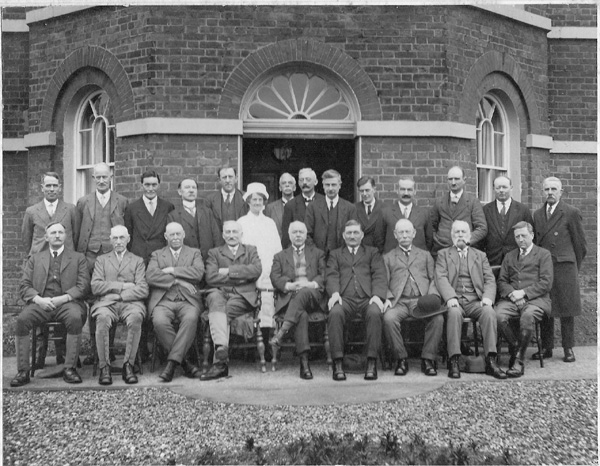
The Board of Guardians and staff outside the Master's House
Photograph by J.H. Turnham, undated (1930s?)
The man in the centre of the back row with a white moustache is William Norris Midgley, the Clerk
Hospital
Winslow Hospital (The Heart of a Bucks Market Town) was written by the late Dr Peter Rudd in 1984 and is reproduced here by permission of his family. It describes the origins of the Workhouse, how it changed to a Public Assistance institution in the 1930s, and then a hospital from 1946 onwards, with wards for geriatric and "mental defective" patients, a short-lived maternity unit, and out-patient facilities, until it closed in 1978 and was largely demolished in 1983. It also includes a foreword about Dr Rudd himself by V.E. Lloyd Hart. Click on the image below to read the pamphlet in PDF format (581 KB):
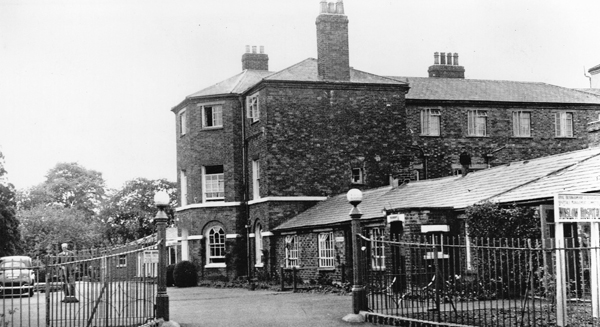
The sign to the right of the gate welcomes visitors to Winslow Hospital in the 1950s
See also:
Vera Bennett remembers working at Winslow Hospital (MP3 file)
Eliza Kirk - from Winslow Workhouse to Hope Island Lighthouse (about an inmate in the 1830s-40s)
William Ovitts (an inmate in 1825)
Winslow on The Workhouse website (opens in new window) - includes transcription of the 1881 Census